Anyone shopping for fluid handling equipment has probably come across both terms and wondered if they’re describing two completely different machines or simply the same thing with two different labels. It’s a fair question, and one that trips up even experienced buyers, because the two terms get used almost interchangeably in casual conversation, on product listings, and sometimes even in technical brochures.
The short answer is that a metering pump and a dosing pump are, for most practical purposes, the same piece of equipment viewed from two different angles. One name focuses on precision, the other on purpose. Understanding how these terms overlap and where they diverge can help you choose the right pump for your process, avoid overspending on unnecessary features, and have a clearer conversation with your supplier about what you actually need.
Same Machine, Different Focus
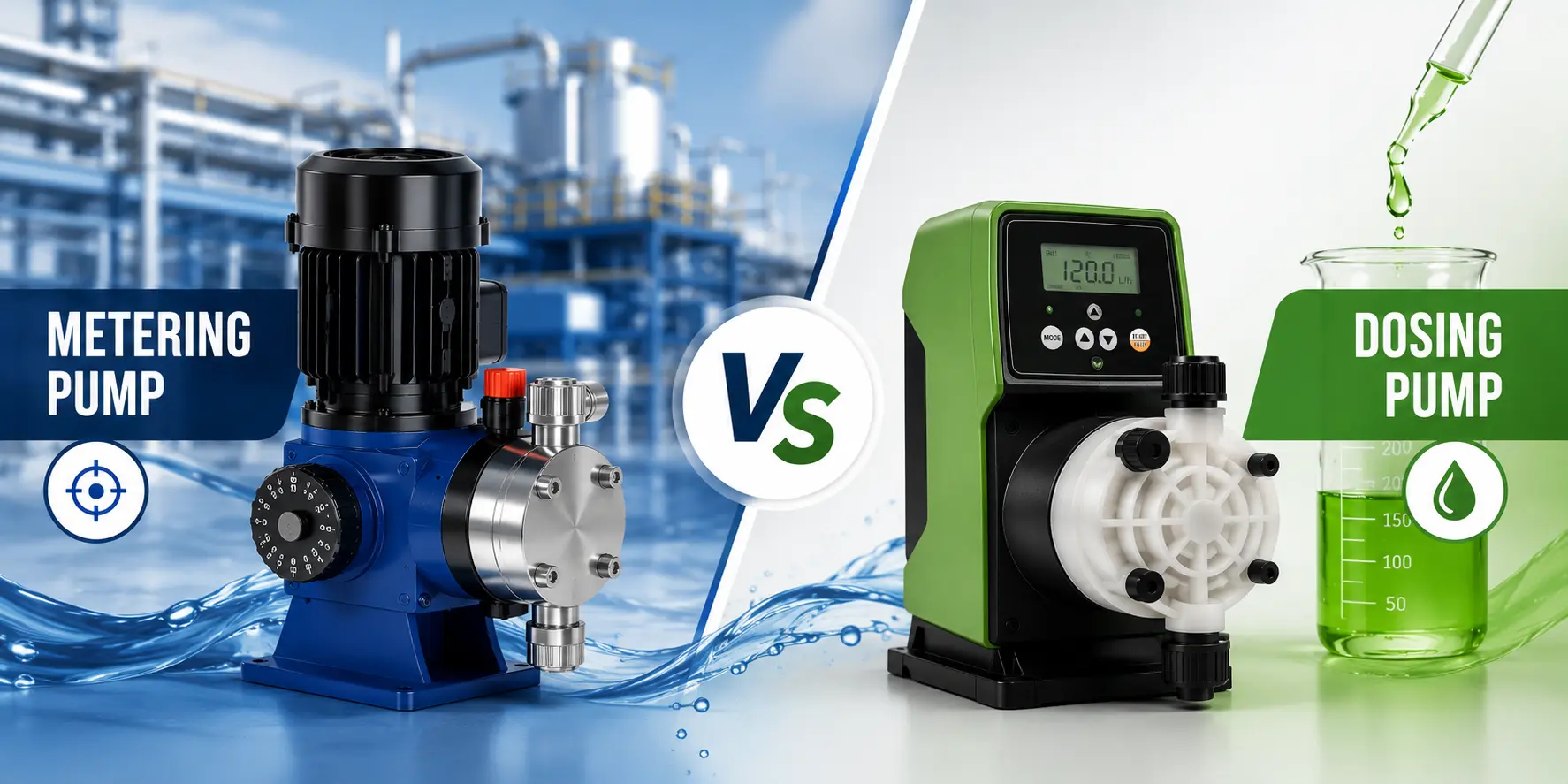
A metering pump is named for what it does mechanically: it delivers a precisely measured, or “metered,” quantity of fluid over a set period. The emphasis is on accuracy and repeatability. These pumps are engineered to move exact volumes with minimal variance, which is essential in applications like water treatment, chemical injection, and pharmaceutical manufacturing, where too much or too little of a substance can cause real problems downstream.
A dosing pump, on the other hand, is named for its purpose: adding a “dose” of one substance into another, usually a chemical into a larger fluid stream. The focus here is on the outcome rather than the mechanism. When someone talks about dosing chlorine into a swimming pool or adding a coagulant into a water treatment line, they’re describing the job the pump performs, not necessarily how finely calibrated its output needs to be.
In practice, most pumps sold as dosing pumps use the same internal mechanisms as metering pumps, from diaphragm designs to piston or peristaltic ones. A dosing pump needs maintenance just like any other precision equipment, and the two terms are often used to describe the same physical unit depending on which industry or region you’re in.
Where the Terminology Splits
Despite the overlap, there are contexts where the distinction becomes more meaningful.
- Precision level. Metering pumps are typically associated with tighter tolerances, sometimes accurate to within 1 percent or better. Dosing pumps used for simpler applications, like garden irrigation feeders, may not require the same level of precision.
- Industry usage. Water and wastewater treatment professionals tend to favour the term “dosing pump,” while pharmaceutical, food processing, and laboratory settings lean towards “metering pump.”
- Regulatory framing. In some regions and industries, “metering” carries a stricter regulatory or calibration connotation, particularly where volumes must be logged and verified for compliance purposes.
None of this means one term is more correct than the other. It largely comes down to convention within a particular field, and suppliers will often use both terms on the same product page to cover how different customers search for and describe the equipment.
Common Pump Types Behind Both Names
Regardless of which term a supplier uses, the underlying technology usually falls into a handful of categories:
| Pump Type | How It Works | Typical Use |
| Diaphragm pump | A flexing diaphragm draws in and expels fluid | Chemical dosing, water treatment |
| Piston pump | A reciprocating piston displaces a fixed volume | High-pressure, high-precision dosing |
| Peristaltic pump | Rollers compress a flexible tube to move fluid | Low-viscosity or shear-sensitive fluids |
| Solenoid-driven pump | An electromagnetic actuator drives short, rapid strokes | Small-scale, intermittent dosing |
Each design has strengths depending on the chemical involved, the required flow rate, and how the pump will be integrated into the wider system. A supplier who understands your process can usually recommend the right type without you needing to memorise the technical differences yourself.
Why the Distinction Still Matters for Buyers
Even though the two terms describe largely the same category of pump, knowing which language a supplier or industry uses can save time when researching products or requesting quotes. If you search only for “dosing pump” but your supplier’s catalogue is organised under “metering pump,” you might miss options that would otherwise suit your needs perfectly.
It also helps to think about your actual requirements instead of the label on the box. Ask yourself how precise the dosing needs to be, what chemical or fluid is involved, how it will be integrated with existing controls, and which features, like variable stroke length or digital flow monitoring, you actually need. These practical questions have a far bigger impact on the outcome than the name printed on the pump.
Choosing the Right Pump for Your Application
A few points worth keeping in mind when comparing options:
- Confirm the chemical compatibility of the pump’s wetted parts, particularly for corrosive or viscous fluids.
- Check the flow rate range and how it can be adjusted, manually or via automation.
- Consider your requirements for remote monitoring or integration with a control system.
- Factor in maintenance access, since some designs are easier to service on site than others.
- Ask about warranty and local support, especially for equipment running continuously in industrial settings.
Getting these details right at the selection stage tends to prevent far more headaches than trying to retrofit a mismatched pump later on.
Final Thoughts
At the end of the day, call it a metering pump or a dosing pump, and you’re generally talking about the same type of equipment built to deliver fluids with control and consistency. The terminology split comes down to industry habit and emphasis more than a meaningful technical divide, though it always pays to clarify with your supplier exactly what level of precision your process demands.
If you’re weighing up your options and want guidance from people who work with pumps, compressors, and aerators every day, get in touch with Winston Engineering.

Author Bio
Team Winston Engineering

Team Winston Engineering is made up of pump specialists, engineers, and industry experts with over 40 years of hands-on experience in fluid management solutions. Founded in Singapore in 1977, Winston Engineering has grown into Southeast Asia's leading pump specialist, serving industries ranging from oil and gas to water treatment, HVAC, and power generation. With regional offices across Singapore, Malaysia, Indonesia, and China, the team brings deep technical expertise and a customer-first approach to every project, backed by the region's only state-of-the-art pump test bay.
See all posts by Team Winston Engineering »