
Quick answer: A roots blower is a positive-displacement air blower that supplies pressurized air to wastewater treatment tanks, aquaculture ponds, and pneumatic conveying lines. In Sri Lanka, where plants run blowers continuously and electricity is one of the largest recurring operating costs, the blower’s design efficiency matters as much as its price tag. The TAIKO SSR series — a three-lobe helical roots blower engineered in Japan — is built specifically to reduce that long-run energy cost while lowering noise and extending service intervals compared to older twin-lobe designs.
Sri Lanka’s water and wastewater sector is expanding — from municipal treatment upgrades around Colombo and Gampaha to export-driven aquaculture operations along the northwestern coast, to garment and food-processing plants running pneumatic systems around the clock. Every one of these operations depends on one component that rarely gets attention until it fails: the blower. This guide covers how a roots blower works, where it’s used across Sri Lankan industry, what actually separates a good blower from a mediocre one, and where the TAIKO SSR series fits.
What Is a Roots Blower and How Does It Actually Work?
A roots blower is a type of positive-displacement pump. Two or three lobed impellers rotate in opposite directions inside a casing, maintaining a razor-thin clearance without ever touching. As they turn, they trap pockets of air and carry them from the suction side to the discharge side. Critically, no compression happens inside the casing itself — air is only compressed the instant it meets the resistance of the downstream pressure at the discharge port.
That single mechanical detail is what separates a blower that runs quietly for fifteen years from one that needs constant attention:

This is the core engineering reason three-lobe helical blowers have become the preferred choice for continuous-duty applications like aeration, where a blower may run 8,760 hours a year without stopping.
Where Roots Blowers Are Used Across Sri Lankan Industry
- Municipal and industrial wastewater treatment — supplying oxygen to activated sludge basins and aeration tanks. This is the single largest application by installed volume as Sri Lanka’s treatment infrastructure expands.
- Aquaculture and shrimp farming — maintaining dissolved oxygen levels in ponds along the northwestern and eastern coastal belts, where the export aquaculture industry depends on stable, round-the-clock oxygenation.
- Pneumatic conveying — moving powders, cement, grain, and other bulk materials through pipelines in manufacturing and agri-processing plants.
- Vacuum packing and food processing — generating the negative pressure needed for packaging lines in food export operations.
- Textile and garment manufacturing — supporting general process air and pneumatic handling systems in one of Sri Lanka’s largest industrial employers, concentrated in zones like Katunayake and Biyagama.
Inside the TAIKO SSR Series
TAIKO KIKAI, the Japanese manufacturer behind the SSR line, built it around a three-lobe helical rotor specifically to solve the noise and efficiency drawbacks of older roots blower designs.
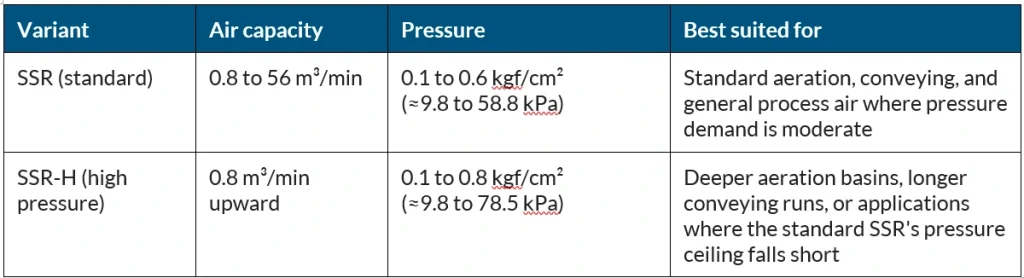
The series is available in two variants, and choosing between them is largely a question of how much pressure your process needs:
Key specifications:
- Bore size range of 50 to 250A, giving plant engineers enough increments to match pipework and flow requirements without oversizing.
- Required motor power from 0.75 to 160 kW, spanning small process applications up to large municipal and industrial installations.
- Oil-free operation, so discharged air doesn’t pick up lubricant contamination — important for food-grade lines and environmentally sensitive processes.
- Compact footprint and lower weight relative to output, which matters in retrofit projects where plant room floor space is already fixed.
- Rated applications span wastewater aeration, fish and aquaculture care, tank back-washing, vacuum packing for food, and even combustion air supply for fireplace and burner systems — a wider range than most engineers associate with a “wastewater blower.”
Why the efficiency gap matters more than the price gap: a blower running continuously in a treatment plant will consume many times its purchase price in electricity over a typical service life. A few percentage points of volumetric efficiency, compounded over ten or more years of 24/7 operation, is usually worth more than any discount on the equipment itself. This is the calculation plant engineers should be running — total cost of ownership, not sticker price.
How to Choose the Right Roots Blower for Your Plant
Four questions determine the right model and size, and getting any one of them wrong is the most common reason blowers underperform or fail early:
- What airflow and pressure does the process actually require? This comes from tank volume, oxygen demand calculations, or conveying distance — not a rule-of-thumb “go bigger to be safe” approach, which usually just wastes electricity.
- What is the blower actually moving? Clean air, humid air, or air carrying particulates each require different seal and filtration configurations.
- How continuous is the duty cycle? A blower cycling on and off has different bearing, lubrication, and thermal considerations than one running nonstop in an aeration basin.
- What’s the ambient operating environment? Sri Lanka’s heat and humidity affect motor derating and cooling needs in ways that a spec sheet built for a temperate-climate market won’t account for — this is a frequent, avoidable sizing mistake.
Maintenance Practices That Extend Service Life
Even a well-selected blower underperforms without basic upkeep. The practices that matter most:
- Gear case oil changes on schedule, not just when the unit sounds different — by the time a problem is audible, wear has usually already occurred.
- Regular bearing inspection, since bearing failure is the most common cause of unplanned roots blower downtime.
- Correct belt tension or coupling alignment, checked at commissioning and periodically afterward — misalignment quietly shortens the life of both the blower and the motor.
- Inlet air filtration, especially in dusty plant environments, to prevent particulate ingress from accelerating lobe and bearing wear.
Frequently Asked Questions (FAQ)
1. What’s the difference between a roots blower and a centrifugal blower?
A roots blower delivers a relatively constant flow rate regardless of downstream pressure changes, which suits processes like aeration where flow consistency matters most. A centrifugal blower’s output varies more with system pressure, making it better suited to different applications.
2. How long does a roots blower typically last?
With proper maintenance — scheduled gear case oil changes, timely bearing checks, and correct alignment — industrial roots blowers commonly run for well over a decade in continuous service.
3. Is the TAIKO SSR series suitable for retrofitting an older treatment plant?
Yes. With bore sizes from 50 to 250A and motor power from 0.75 to 160 kW across the SSR and SSR-H variants, there’s enough range to closely match an existing footprint without major civil works.
4. Why does a three-lobe design cost more upfront than a twin-lobe blower, and is it worth it?
The helical three-lobe rotor is more complex to manufacture, which shows up in the purchase price. For continuous-duty applications, the lower energy consumption and reduced mechanical wear typically recover that difference well within the equipment’s service life.

Author Bio
Javier

Javier is a Marketing Executive at Winston Engineering with a strong foundation in digital marketing, content creation, and SEO. Holding a Bachelor's degree in Marketing from UTAR, he brings a blend of creative and analytical skills to the team, managing everything from social media and Google Ads to video production and website content. Javier's expertise spans Adobe Illustrator, Adobe Premiere Pro, Google Analytics, and CMS platforms, making him a versatile contributor to Winston Engineering's growing digital presence across the region.
See all posts by Javier »