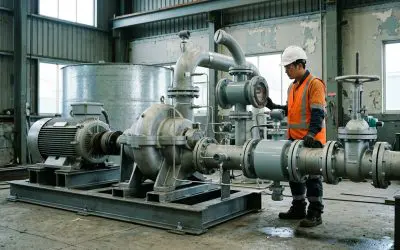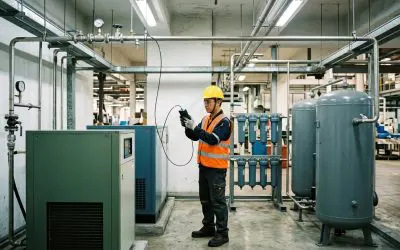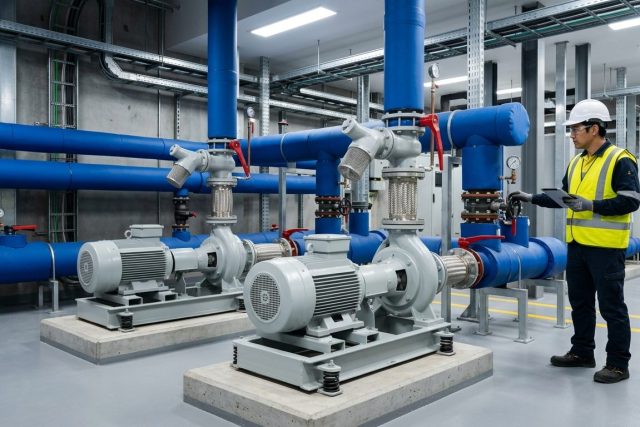
Cooling is the part of a data centre that never gets to pause. Servers tolerate a great many things, and a loss of heat rejection is not among them, which places the chilled water pumps in the small group of components whose failure the whole facility is designed around.
Singapore’s position as a regional digital hub has made this a busy specification area, and the efficiency expectations attached to new capacity here travel directly into the mechanical plant room. Pump selection is where a good deal of that expectation is either met or quietly conceded.
Why Cooling Duties Are Shifting
Two changes are reshaping the hydraulics. Operators are running chilled water warmer than they once did, because higher supply temperatures improve chiller efficiency and free up capacity, and modern IT equipment tolerates it comfortably. That direction of travel is consistent with IMDA’s announcement of a Green Data Centre Roadmap, which set out at least 300 megawatts of additional capacity in the near term alongside a push on energy efficiency and green energy.
At the same time, high-density racks are driving adoption of liquid cooling, where heat is captured close to the chip and rejected through a coolant distribution unit into the building’s water system. That adds a second, smaller hydraulic circuit with its own filtration and material requirements.
The consequence for pump selection is that the duty a designer is given today may look nothing like the duty the same building would have specified five years ago. Selecting pumps for data centre cooling now starts with a conversation about temperatures and densities before anyone opens a selection program.
Redundancy Comes First
Concurrent maintainability is usually a design requirement, meaning any single item of plant can be isolated for service without reducing cooling to the load. For pumps that translates into redundant units on separate electrical supplies, valved so one can be worked on while the others carry the duty, with the standby capable of taking over without manual intervention.
Flow Follows the Delta-T
Flow rate is set by the heat load and the temperature difference the system is designed to achieve, so a wider delta-T means less water for the same kilowatts. Smaller flow allows smaller pipework, smaller pumps and lower pumping energy, which is why designers push the difference as far as the coils and control valves allow.
The trap is that a design delta-T only holds if the terminal equipment achieves it. Where valves leak by, coils foul or control loops hunt, return temperature drops, flow rises to compensate and the pumps end up working harder than the calculation ever suggested. Selecting with a little curve to spare on the right-hand side gives the system somewhere to go when that happens.
The Part-Load Years
Data centres fill gradually. A hall designed for a full IT load may run at a fraction of it for the first years of operation, and pumps chosen only for the design condition will spend that period far to the left of their best efficiency point.
Staging is the usual answer. Multiple smaller pumps allow capacity to be added as the load arrives, and variable speed drives let each unit follow demand within its efficient band. Sizing the first stage for the expected early load, with space and provision for later units, avoids paying an efficiency penalty for years in order to be ready for a load that has not yet arrived.
Minimum flow through the chillers sets a floor on how far the system can turn down. Variable primary flow arrangements handle this with a bypass and careful control, while primary and secondary arrangements decouple the two circuits at the cost of an extra set of pumps. Either can work well, and the choice belongs with the overall control philosophy.
Liquid Cooling Adds a Second Loop
Coolant distribution units introduce technology-side circuits that behave differently from a building chilled water system. Flow rates are modest, heads can be relatively high, filtration is fine, and cleanliness has a direct effect on the narrow channels inside cold plates.
Material compatibility governs everything on that side. Treated water, glycol mixtures and specialist fluids each impose their own restrictions on wetted materials and elastomers, and viscosity differences from plain water change both pump performance and pressure loss, so a selection made on water alone will be optimistic.
Suction Conditions and Static Pressure
Tall risers and basement plant rooms combine to make static pressure a live issue. Pump casing pressure ratings, expansion vessel sizing and the position of the pumps relative to the system’s neutral point all need checking together, and available NPSH at the pump inlet should be confirmed at the warmest water temperature the system will run.
Instrumentation and Control
Differential pressure sensing at the hydraulically most remote branch, sometimes called the index run, gives speed control a signal that reflects the system rather than the plant room. Sub-metering pump energy separately from chillers turns efficiency claims into measurements, and it makes drift visible long before anyone notices a temperature.
Continuous monitoring has become straightforward enough that leaving it out is now the unusual choice. Facilities using IoT and smart controls on rotating equipment can watch vibration, bearing temperature and power trend together, which is precisely the kind of early warning a facility with no tolerance for downtime should want.
Commissioning and Handover
Balancing a chilled water system at low load and expecting it to behave at full load is optimistic. Where the eventual load is not available at handover, load banks give a realistic test, and the results should be recorded against each stage of the pump arrangement.
Factory testing of packaged pump sets removes a good deal of uncertainty before delivery. WE Integrate builds and checks skid-mounted sets as complete units, and WE Test verifies performance against the specified duty, which is a shorter conversation than resolving a shortfall on a live site.
Documentation closes the loop. Curves, test records, valve settings, control setpoints and the as-commissioned readings form the reference the operations team will use for the next decade, and they are far easier to collect at handover than to reconstruct afterwards.
Building In the Headroom You Will Need
Cooling duties in this sector keep moving, so the useful question is not only what the facility needs on day one but how gracefully the plant handles change. Staged capacity, honest delta-T assumptions and instrumentation that shows what is happening all buy that flexibility.
If you are working on a data centre project, a retrofit to higher water temperatures or a technology-side circuit for liquid cooled racks, talk to Winston Engineering. Our team is glad to help you match the equipment to a load that will keep growing.

Author Bio
Team Winston Engineering

Team Winston Engineering is made up of pump specialists, engineers, and industry experts with over 40 years of hands-on experience in fluid management solutions. Founded in Singapore in 1977, Winston Engineering has grown into Southeast Asia's leading pump specialist, serving industries ranging from oil and gas to water treatment, HVAC, and power generation. With regional offices across Singapore, Malaysia, Indonesia, and China, the team brings deep technical expertise and a customer-first approach to every project, backed by the region's only state-of-the-art pump test bay.
See all posts by Team Winston Engineering »