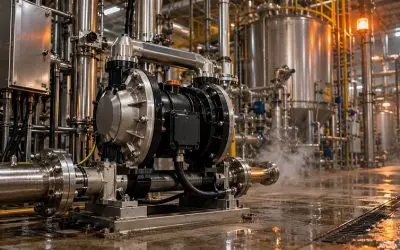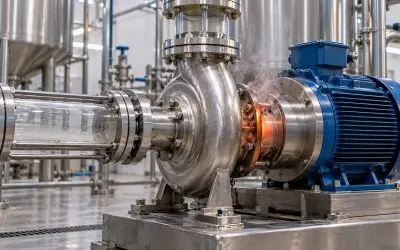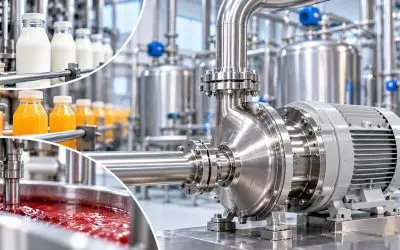
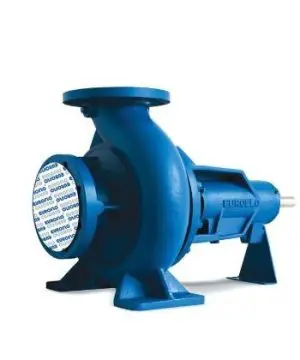
Selecting a centrifugal pump should not be based solely on the maximum specifications listed in a catalog. For example, the Euroflo End Suction Centrifugal Pump range from the Winston Indonesia catalog offers a maximum capacity of up to 1,100 m³/h, a maximum head of 150 meters, a pressure rating of up to 16 bar, and operating temperatures of up to 105°C. However, these maximum values will not occur simultaneously under normal operating conditions.
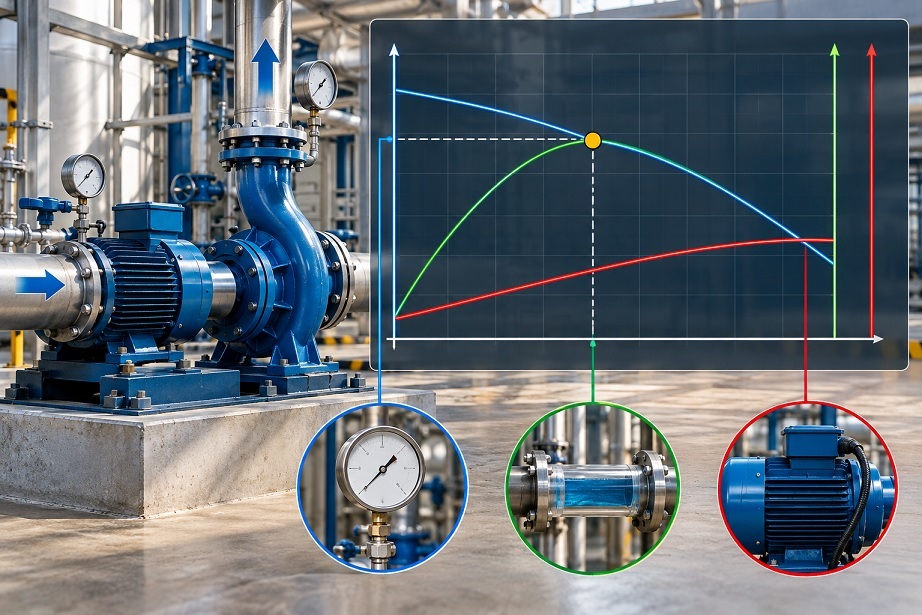
To ensure that a pump operates safely, efficiently, and reliably, you need to read the performance graph, or pump curve, for the selected model and impeller diameter. The following is a practical guide to reading a pump curve:
Understand the Graph Axes (Flow and Head)
Horizontal Axis (X): Shows the flow rate or pumping capacity, typically expressed in units such as m³/h or liters per second.
Vertical Axis (Y): Shows the total head, which represents the energy provided by the pump to overcome elevation differences and friction losses throughout the piping system. It is typically expressed in meters.
How to Determine the Duty Point: Plot the required operating conditions on the graph. For example, if your system requires a flow rate of 200 m³/h at a total head of 60 meters, the intersection of these two values represents the Duty Point. The selected pump curve should pass through or come as close as possible to this point.
Understand the Relationship Between Flow and Head
In a centrifugal pump, head generally decreases as flow increases. Avoid operating the pump continuously at the shut-off head condition, where flow is close to zero and head is at its maximum, or at the far right end of the curve, where excessive flow can lead to cavitation, increased power consumption, and motor overload.
Find the Best Efficiency Point (BEP)
The BEP is the operating point where the pump achieves its highest efficiency.
- Field Tip: Ideally, the duty point should be located as close as reasonably possible to the BEP.
- If a pump is significantly oversized and operates far from its BEP, internal flow conditions can become unstable, potentially causing excessive vibration and accelerating wear on components such as bearings and mechanical seals.
Pay Attention to the Impeller Diameter
A typical pump curve may display several performance curves corresponding to different impeller diameters.
- A larger impeller diameter generally produces a higher head, while a smaller impeller diameter produces a lower head.
- Select an impeller diameter that matches your duty point as closely as possible to avoid unnecessary energy consumption.
Check the Efficiency, Power, and NPSHr Curves
Efficiency & Power Curves: Make sure the electric motor has sufficient capacity throughout the expected operating range to minimize the risk of motor overload.
NPSHr (Net Positive Suction Head Required): Indicates the minimum suction-side pressure head required by the pump to avoid cavitation. Cavitation can produce a characteristic noise similar to gravel passing through the pump and can damage the impeller over time. Make sure that the system’s NPSH Available (NPSHa) is higher than the pump’s NPSHr, with an appropriate safety margin.
Example: Reading a Pump Curve in the Field
To make the pump selection process more practical, let’s look at a real-world example based on the performance curve of the Euroflo End Suction Centrifugal Pump (Model EU 50-26 MBC).
As a visual reference, the following example illustrates the type of data and pump curve information commonly reviewed by technical teams.
- Required System Duty Point:
- Flow Rate = 75 m³/h
- Head = 76 meters
- Motor Specification: 37 kW, 400 V, 50 Hz, rotational speed of 2,900 rpm.
How to Read the Pump Curve
1. Determine the Duty Point
Plot the required flow rate of 75 m³/h on the horizontal axis and the required head of 76 meters on the vertical axis. The intersection falls directly on the performance curve for the ⌀264 mm impeller, indicating that this impeller size is suitable for the required operating point.
2. Check the Efficiency (BEP)
At this operating point, the curve indicates an efficiency of 62.6%. The operating point is located within the pump’s high-efficiency region, close to the Best Efficiency Point (BEP). This indicates that the pump can operate efficiently while helping minimize unnecessary energy consumption and mechanical stress.
3. Check the Shaft Power
Based on the shaft power curve, the pump requires approximately 28.3 kW at the specified operating point. Since the installed motor has a rated capacity of 37 kW, the motor has sufficient capacity to handle the pump’s power requirement without operating at its rated limit.
4. Check the NPSHr
The NPSHr curve indicates a value of approximately 3.01 meters at the specified flow rate. The NPSH Available (NPSHa) at the installation should be higher than this value, with an appropriate safety margin, to help prevent cavitation.
Conclusion & Consultation
Accurately reading a pump curve can help prevent unnecessary energy consumption, improper pump selection, and premature equipment failure. When selecting the appropriate material—whether cast iron, ductile iron, stainless steel, or bronze—as well as determining suitability for specific fluid temperatures and pressure conditions, always refer to the manufacturer’s official datasheet and technical documentation.
Need help reading a pump curve or selecting the right Euroflo End Suction Pump specification for your project? Contact the Winston Indonesia Technical Team
Related Products

Author Bio
Rian

Team PT Winston technically driven member of PT Winston Indonesia with strong practical knowledge of pumps and fluid handling solutions. We work closely with customers to understand their operating requirements, recommend suitable pump solutions, and introduce products that can improve reliability, efficiency, and overall system performance. With a hands-on and solution-oriented approach, We help bridge technical requirements with practical product selection, ensuring customers receive the right pumping solution for their applications.
See all posts by Rian »