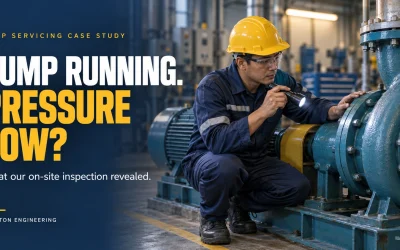
The pump was running. So why wasn’t the water pressure enough?
When a water supply system isn’t delivering enough pressure, the first instinct is usually:
“The pump must be faulty.”
But in this case, that wasn’t the problem.
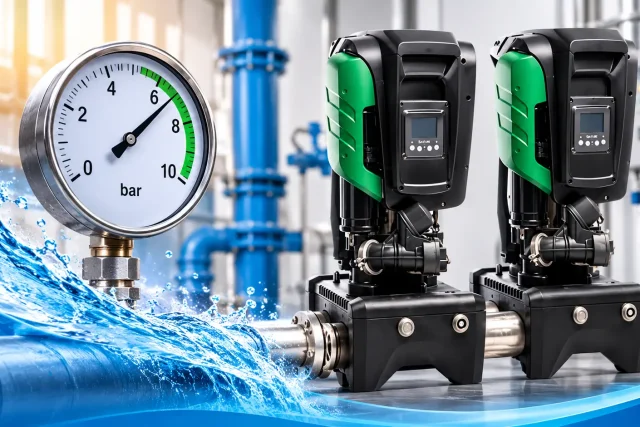
Winston Engineering was called in to investigate a system experiencing low water pressure. Our inspection found that the pump was actually operating properly and producing around 3–5 bar.
So, what was going on?
The Challenge
The system was being operated manually, with two pumps intended to operate one at a time. However, only one pump was functioning during our inspection.
When more flow was required, the pump could not provide enough pressure to meet the water demand. It continued running and eventually tripped.
That gave us the key clue:
The pump wasn’t necessarily failing. It simply wasn’t enough for the job.
Root Cause Analysis
Our technical assessment found that a single pump was insufficient to provide the required water supply.
In other words, the pump could do its job — but the system needed more pumping capacity than one pump could provide.
This is an important distinction.
Replacing a perfectly functioning pump with another similar pump wouldn’t address the real issue. The system configuration itself needed to change.
Winston Engineering’s Solution
Our team recommended upgrading the existing arrangement to a two-pump booster set system.
The idea was simple:
Instead of making one pump work harder, give the system the pumping capacity it actually needs.
The customer proceeded with the booster set installation.
The Result
After the booster set was installed, the water pressure and water supply met the required demand.
No unnecessary pump replacement. No guessing. Just the right system configuration for the actual requirement.
The Engineering Lesson
Low pressure doesn’t always mean a bad pump.
Sometimes, the real issue is that the existing system simply doesn’t have enough capacity.
That’s why at Winston Engineering, we don’t just look at whether a pump is running. We look at the bigger picture — pump performance, system demand and configuration — to find the solution that actually fits the application.
Frequently Asked Questions
The investigation found that one pump did not have sufficient capacity to meet the required water supply demand.
No. The pump was found to be operating in good condition and producing around 3–5 bar. The issue was that its capacity was insufficient for the required demand.
When more flow was required, the pump could not meet the demand and continued running until it eventually tripped.
Winston Engineering determined that one pump was insufficient for the required water supply. A two-pump booster set was recommended to provide the necessary pumping capacity.
Yes. After installation, the water pressure and water supply met the required demand.
Don’t assume the pump is faulty immediately. Check the pump’s operating condition, system demand, available pumping capacity and overall pump configuration before deciding on a replacement.

Author Bio
Mandy Wong

Mandy is a Marketing Assistant at Winston Engineering and a graduate in Digital Marketing from Taylor's University. Passionate about digital marketing, content creation, and SEO, she creates informative content that makes technical topics easier to understand. With experience in social media and multimedia content, Mandy helps strengthen Winston Engineering's digital presence through clear, engaging, and customer-focused communications.
See all posts by Mandy Wong »