Two blower packages can be quoted for the same aeration tank, hit the same design airflow at the same discharge pressure, and behave nothing alike once the plant starts running. One holds its efficiency across the day while the other spends most of its hours blowing off air it does not need. The difference sits in the machine’s operating principle, not in the datasheet headline.
Blower selection for wastewater treatment, pneumatic conveying and process aeration in Singapore usually narrows to two families: positive displacement rotary lobe machines, still widely called roots blowers, and single-stage high-speed centrifugal machines, generally sold as turbo blowers. Understanding how each responds to a changing system is the shortest route to a sound specification.
Two Ways to Move the Same Air
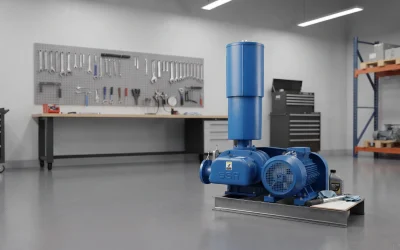
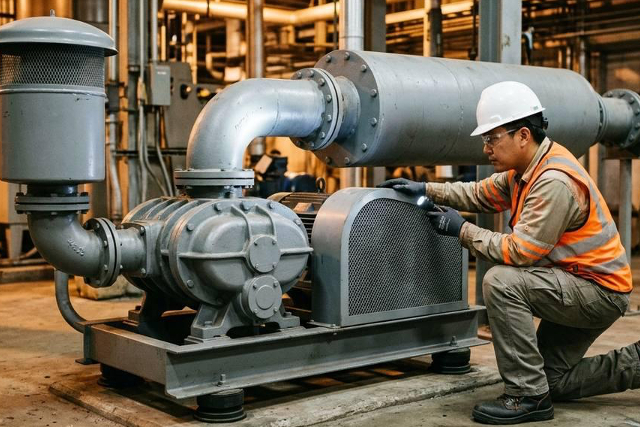
A positive displacement blower traps a fixed volume of air between rotating lobes and pushes it out against whatever pressure the system presents. Volume flow follows shaft speed almost linearly, and discharge pressure is set by the resistance downstream. Power rises with pressure, so the machine keeps delivering air as tank level or filter loading changes.
A dynamic machine works the other way. A high-speed impeller adds velocity to the air, which the diffuser converts into pressure, and the flow that results depends on the pressure the system demands. Move along the curve and both flow and efficiency shift. A turbo blower in Singapore is typically a single-stage unit running at very high shaft speed on airfoil or magnetic bearings, driven through an integral variable speed drive.
That architectural difference explains most of what follows. Positive displacement machines are tolerant of pressure variation and indifferent to it. Dynamic machines are efficient near their design point and constrained at the extremes, with a surge limit at low flow that the control system has to respect.
Where Roots-Type Blowers Earn Their Place
Duties with an unstable or poorly defined back pressure suit positive displacement equipment. Pneumatic conveying is the clearest example, since the pressure needed to move material changes with the load in the line. A roots blower handling that duty simply works harder as pressure rises, without approaching an aerodynamic limit.
Mechanical simplicity is the second attraction. Lobes, timing gears, bearings and a belt or coupled drive are familiar to most maintenance teams, spares are straightforward, and an in-house fitter can carry out much of the routine work. For smaller plants, or sites where an overhaul has to be done during a short shutdown window, that familiarity carries real weight.
Where Turbo Blowers Pull Ahead
Continuous duties with a stable pressure profile favour the dynamic machine. Diffused aeration in a fixed-depth tank is the textbook case: the static head barely changes, the airflow requirement follows the biological load, and a high-speed impeller with an integral drive can track that requirement closely while staying near its best efficiency point.
Oil-free operation is the second advantage where air quality is a consideration. Airfoil and magnetic bearing designs remove the lubricated gearbox from the airstream entirely, which also removes an oil change interval from the maintenance schedule.
Footprint and noise complete the picture. Packaged turbo units arrive as enclosed skids with the drive, filtration, instrumentation and acoustic housing already fitted, so what a congested Singapore plant room has to accommodate is a single cabinet with an inlet and a discharge. The types of aeration systems serving a given tank will influence how much of that packaged capability is genuinely useful, since a coarse bubble system and a fine bubble system present very different pressure requirements.
Comparing the Two on Paper
Direct comparison is easier when the criteria are set out side by side, provided the figures behind them come from the specific packages under consideration and not from category generalisations.
| Consideration | Roots-type positive displacement | Single-stage turbo |
|---|---|---|
| Flow response | Follows speed, largely independent of pressure | Follows the pressure the system presents |
| Pressure tolerance | Accepts wide variation without aerodynamic limit | Constrained by surge at low flow |
| Efficiency profile | Broadly flat across the operating band | Highest near the design point |
| Typical control | Speed control, sometimes staged units | Integral variable speed drive with wide modulation |
| Maintenance model | Familiar mechanical work, oil and belt service | Oil-free bearings, fewer wearing parts, specialist support |
Turndown Is Usually the Deciding Factor
Aeration demand at a municipal works rises and falls through the day, and the ratio between peak and minimum airflow decides which technology fits. Where that ratio is modest, either family can be controlled sensibly. Where minimum demand falls to a small fraction of peak, a single large machine of either type will struggle, and the answer is usually multiple smaller units brought on in sequence.
Dissolved oxygen control ties the equipment to the process. A control loop that trims airflow to hold a dissolved oxygen setpoint will only deliver savings if the blower can actually follow it without hunting or riding against its low-flow limit, so the turndown claim in a quotation deserves the same scrutiny as the efficiency figure.
What the Tropics Add to the Calculation
Inlet air temperature and humidity affect density, and density affects mass flow, so a blower selected on standard reference conditions can under-deliver in a hot plant room during the afternoon. Specifying the duty at the site’s realistic worst-case inlet condition, and keeping the intake away from radiated heat and process exhaust, is a small piece of design discipline that pays for itself over a long service life.
Reading Performance Claims Honestly
Comparing bare shaft efficiency between a positive displacement machine and a dynamic one tells you very little, because each package includes different losses. Filters, silencers, drives, cooling fans and control electronics all draw power, and the number the plant pays for is the wire-to-air figure at the actual duty point.
The ASME PTC 13 wire-to-air performance test code was written to make that comparison possible on a consistent basis across blower technologies. Asking for package performance stated on that basis, at your duty rather than at a convenient reference point, turns a marketing comparison into an engineering one.
Choosing With the Duty in Front of You
Neither family is the better machine in the abstract. Stable pressure with a wide airflow requirement points one way, variable pressure with a simpler maintenance regime points the other, and plants with mixed duties often run both under one roof quite happily.
Our WE Supply team works with equipment from established manufacturers across both technologies, and WE Service supports installed units once they are running.
If you are weighing up options for a new plant, an upgrade or a replacement machine, talk to Winston Engineering about the duty you need to cover, and we will help you compare the choices on the same terms.

Author Bio
Team Winston Engineering

Team Winston Engineering is made up of pump specialists, engineers, and industry experts with over 40 years of hands-on experience in fluid management solutions. Founded in Singapore in 1977, Winston Engineering has grown into Southeast Asia's leading pump specialist, serving industries ranging from oil and gas to water treatment, HVAC, and power generation. With regional offices across Singapore, Malaysia, Indonesia, and China, the team brings deep technical expertise and a customer-first approach to every project, backed by the region's only state-of-the-art pump test bay.
See all posts by Team Winston Engineering »