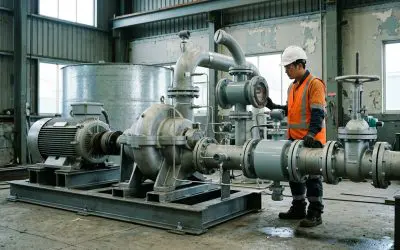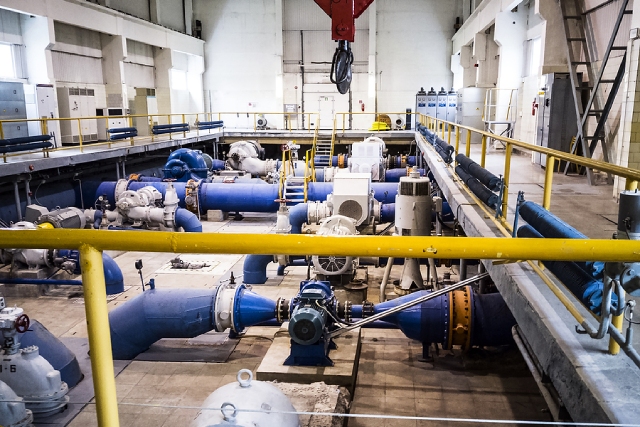
Choosing the right pump for a job often comes down to one number that gets overlooked more than it should: total dynamic head. Get this figure wrong and you end up with a pump that either struggles to deliver water where it needs to go, or one that’s far more powerful (and expensive to run) than the job actually calls for. Understanding how to calculate it properly is one of the simplest ways to save money and avoid headaches down the line.
Whether you’re setting up irrigation for a farm, sizing a system for a residential building, or specifying equipment for an industrial application, total dynamic head sits at the heart of the decision. It’s not a complicated concept once you break it down into its parts, and once you know how the maths works, you’ll be able to size a water pump correctly every time.
What Is Total Dynamic Head?
Total dynamic head, often shortened to TDH, refers to the total resistance a pump has to overcome to move water from one point to another. This includes lifting water vertically, pushing it through pipework, and overcoming friction along the way. Pump manufacturers use this figure to show how their equipment performs at different flow rates, usually presented as a pump curve.
Getting TDH right means your pump operates efficiently, uses less energy, and lasts longer. Getting it wrong tends to lead to poor performance, unnecessary wear, and higher electricity bills.
The Three Main Components of TDH
Total dynamic head is made up of a few different elements that all add together. Breaking each one down makes the whole calculation far less intimidating.
Static head is the vertical distance water needs to travel, measured from the source to the discharge point. This is split into two parts: static suction head (the lift needed to get water out of a source below the pump) and static discharge head (the height water needs to reach above the pump). If your water source sits below the pump and needs to rise ten metres to reach a rooftop tank, that ten metres is your static head.
Friction head accounts for the resistance water experiences as it moves through pipes, fittings, valves, and bends. Longer pipe runs, narrower diameters, and more fittings all increase friction head. This is where many calculations go wrong, because it’s easy to underestimate how much resistance a long stretch of pipework can create, particularly if the system includes several elbows or valves.
Velocity head relates to the energy needed to get water moving at a particular speed. In most everyday systems, this figure is small enough to be almost negligible, but it’s still worth including for accuracy, especially in high flow rate applications.
Some systems, particularly those involving aeration systems, will have additional pressure requirements factored into the overall calculation, though the core principles of static, friction, and velocity head remain the same.
The Basic Formula
The standard formula for total dynamic head looks like this:
TDH = Static Head + Friction Head + Velocity Head
For most residential and small commercial setups, velocity head is small enough that it can often be left out of a rough calculation without causing major inaccuracies. For larger or more demanding systems, though, it’s worth including for a precise result.
Working Through an Example
Say you’re setting up a system where water needs to be pumped from a tank that sits two metres below ground level up to a storage tank fifteen metres above the pump. The pipe run includes several bends and stretches roughly forty metres in total length.
Here’s how the calculation might break down:
- Static suction head: 2 metres
- Static discharge head: 15 metres
- Total static head: 17 metres
- Friction head (based on pipe length, diameter, and fittings): approximately 4 metres
- Velocity head: negligible for this flow rate
Adding these together gives a total dynamic head of roughly 21 metres. This figure is what you would then check against a pump’s performance curve to find a model capable of delivering the flow rate you need at that head.
Common Mistakes to Avoid
A few errors crop up again and again when people work out TDH, and most of them are easy to sidestep once you know what to look for.
- Ignoring friction losses in fittings. Elbows, valves, and reducers all add resistance, and skipping this step tends to result in an underpowered pump.
- Using the wrong pipe diameter in calculations. Even a small mismatch between the actual pipe size and the figure used in friction loss tables can throw off results.
- Forgetting seasonal changes in water level. For systems drawing from a well, borehole, or reservoir, water levels can shift throughout the year, changing the static suction head.
- Overestimating pump performance based on manufacturer specs alone. Real-world conditions, including pipe wear and changing flow demands, often mean actual performance sits lower than the numbers on paper.
Why Getting TDH Right Matters for Efficiency
An oversized pump wastes energy and puts unnecessary strain on components, while an undersized one struggles to meet demand and may end up running constantly, shortening its lifespan. Calculating total dynamic head accurately from the start helps you land on equipment that runs smoothly, uses power efficiently, and holds up over the long term.
This is particularly important for larger installations, where even a small miscalculation can translate into significant differences in running costs over a year. Taking the time to measure pipe runs accurately, account for fittings, and factor in elevation changes pays off in the form of a system that simply works the way it should.
Final Thoughts
Calculating total dynamic head doesn’t need to be treated as a purely technical exercise reserved for engineers. With a clear understanding of static head, friction head, and velocity head, anyone planning a pumping system can work through the numbers with confidence and choose equipment that fits the job properly.
If you’re unsure where to start or want a second opinion on your calculations, the team at Winston Engineering can help you assess your requirements and recommend equipment suited to your specific setup. Get in touch to discuss your project and find a solution that keeps things running smoothly for years to come.

Author Bio
Team Winston Engineering

Team Winston Engineering is made up of pump specialists, engineers, and industry experts with over 40 years of hands-on experience in fluid management solutions. Founded in Singapore in 1977, Winston Engineering has grown into Southeast Asia's leading pump specialist, serving industries ranging from oil and gas to water treatment, HVAC, and power generation. With regional offices across Singapore, Malaysia, Indonesia, and China, the team brings deep technical expertise and a customer-first approach to every project, backed by the region's only state-of-the-art pump test bay.
See all posts by Team Winston Engineering »