Water arriving at a tap on the fortieth storey owes its pressure entirely to what happens in a plant room several hundred metres below. Specify the pump set correctly and nobody in the building ever thinks about it. Specify it loosely and the system announces itself through swinging outlet pressure, frequent starts and a motor drawing more current than the design intended.
Vertical multistage pumps have become the default choice for riser duties across Singapore because they produce high head from a small footprint, which suits the cramped plant rooms typical of local developments. Selecting one properly involves more than finding the catalogue curve that reaches the required pressure.
How Singapore’s Supply Rules Shape the Duty
Every high-rise water system here begins with the same constraint. PUB maintains mains pressure capable of supplying water directly to fittings not exceeding 25 metres above mean sea level, and its handbook on application for water supply sets out what happens above that line.
Premises with fittings between 25 and 37 metres above mean sea level are served by indirect supply through a high level storage tank. Above 37 metres, water is drawn into a low level transfer tank and pumped up to high level tanks sized for a day’s requirement, with a duplicate pump provided against breakdown.
That distinction decides the shape of the duty before any hydraulic calculation begins. A transfer set filling roof tanks works against a largely fixed static head at a fairly steady flow. A boosted distribution set feeding fittings directly works against a static head that barely moves while flow swings hour by hour. The two duties call for different control philosophies, and treating them as interchangeable is where many specifications go astray.
Why Multistage Hydraulics Suit Riser Duties
A multistage pump stacks impellers in series inside a single casing. Each stage adds roughly the same increment of head, so the flow is governed by impeller and channel geometry while total head is governed by how many stages are fitted. The result is a steep performance curve, meaning head changes only modestly as flow varies, which is exactly the behaviour a tall riser needs.
Stage count also gives the specifier a useful lever. Where a survey shows the design head was overstated, trimming a stage brings the pump closer to its best efficiency point without changing the casing, the motor frame or the pipework. Choosing a high efficiency pump in Singapore is therefore as much about landing on the correct number of stages as it is about the efficiency class printed on the motor nameplate.
Establishing the Duty Point
The duty point is built up, not guessed. Engineers who calculate total dynamic head for a riser are adding several independent quantities, each of which needs its own evidence:
- Static lift from the lowest suction water level to the highest point of discharge
- Friction loss along the riser and horizontal mains at the design flow
- Local losses through valves, strainers, meters, bends and tees
- Residual pressure required at the least favourable fitting
- Any pressure needed by downstream equipment such as filtration or a water heater
Design flow deserves particular care. Summing the peak demand of every fitting in a residential block produces a figure no installation will ever see, because occupants do not draw water simultaneously. Loading unit methods and diversity factors exist to bring that number back to reality, and the pump should be sized on the diversified figure with the simultaneous demand profile recorded in the design file.
Blanket safety margins are the other common source of trouble. A generous allowance added at every step compounds into a pump running far to the left of its best efficiency point, where radial loads rise and the motor spends its life part loaded. A single, stated margin applied once is easier to defend and easier to commission against.
Staging, Speed Control and Part-Load Behaviour
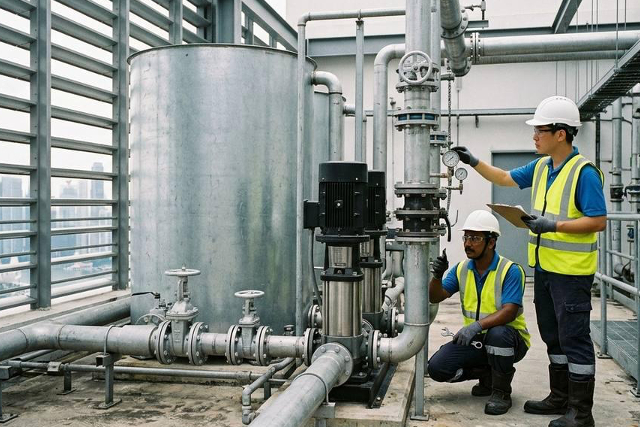
Most Singapore installations use two or more pumps in a packaged set with a common manifold. A duty and standby arrangement suits transfer duties where the flow is predictable. Multiple pumps in parallel under cascade control suit boosted distribution, because units can be brought on and taken off as demand rises and falls through the day.
Variable speed control has become the norm on a booster pump set, holding outlet pressure steady while speed follows demand. Two points are easy to overlook. Affinity relationships mean head falls with the square of speed, so a pump throttled back too far can fail to reach the top of the riser at all. Every pump also has a minimum continuous flow below which internal recirculation and heating begin, and the control philosophy has to respect it.
Suction Conditions and Cavitation Margin
Available NPSH, the net positive suction head at the pump inlet, has to exceed the value the pump requires, with a margin. Tank water in an unshaded roof plant room can sit well above the temperature assumed in a generic calculation, which raises vapour pressure and erodes that margin, so submergence and inlet pipe sizing should be checked against the warmest credible condition on site.
Materials, Seals and Water Quality
Potable duties in Singapore are normally served by stainless steel wetted parts, with the whole installation subject to PUB’s stipulation of standards and requirements for water fittings. Confirming compliance at specification stage avoids awkward conversations at inspection.
Seal selection follows the water. Clean municipal water is undemanding, while transfer tanks that occasionally carry sediment call for a harder face combination and a clean flush arrangement. Where the same set also feeds a cooling or process loop, the chemistry of that loop, not the potable supply, governs the choice.
Mechanical fit inside the plant room is the quiet third factor. Vertical sets need headroom for stack removal, and a set that cannot be dismantled in place turns routine seal work into a lifting exercise.
Verification Before Handover
Performance claimed on a curve and performance delivered on site are separate things. Witnessed testing against the specified duty gives the consultant a documented basis for acceptance, and our WE Test facility at Joo Koon exists for exactly that purpose. Where a set is supplied as a packaged skid, WE Integrate assembles and checks it as a unit before delivery, which shortens the work left to do in a congested plant room.
Commissioning readings are the baseline everything later is measured against. Recording flow, discharge pressure, suction pressure and absorbed current at handover gives the facilities team something concrete to compare against in three years, when the question becomes whether the system has drifted or the building’s demand has changed.
Getting the Specification Right the First Time
Riser duties reward patient arithmetic. The static lift is fixed by the building, the losses follow from the pipework, and the diversified flow follows from how the building is used. Once those three are honest, the pump almost selects itself.
If you are working through a high-rise water supply design, retrofitting an ageing plant room or reviewing a set that no longer suits the building it serves, our engineering team at Joo Koon is glad to look at the numbers with you.
Reach out to Winston Engineering and we will help you match the equipment to the duty your building actually has.

Author Bio
Team Winston Engineering

Team Winston Engineering is made up of pump specialists, engineers, and industry experts with over 40 years of hands-on experience in fluid management solutions. Founded in Singapore in 1977, Winston Engineering has grown into Southeast Asia's leading pump specialist, serving industries ranging from oil and gas to water treatment, HVAC, and power generation. With regional offices across Singapore, Malaysia, Indonesia, and China, the team brings deep technical expertise and a customer-first approach to every project, backed by the region's only state-of-the-art pump test bay.
See all posts by Team Winston Engineering »