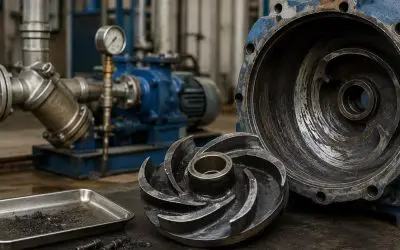
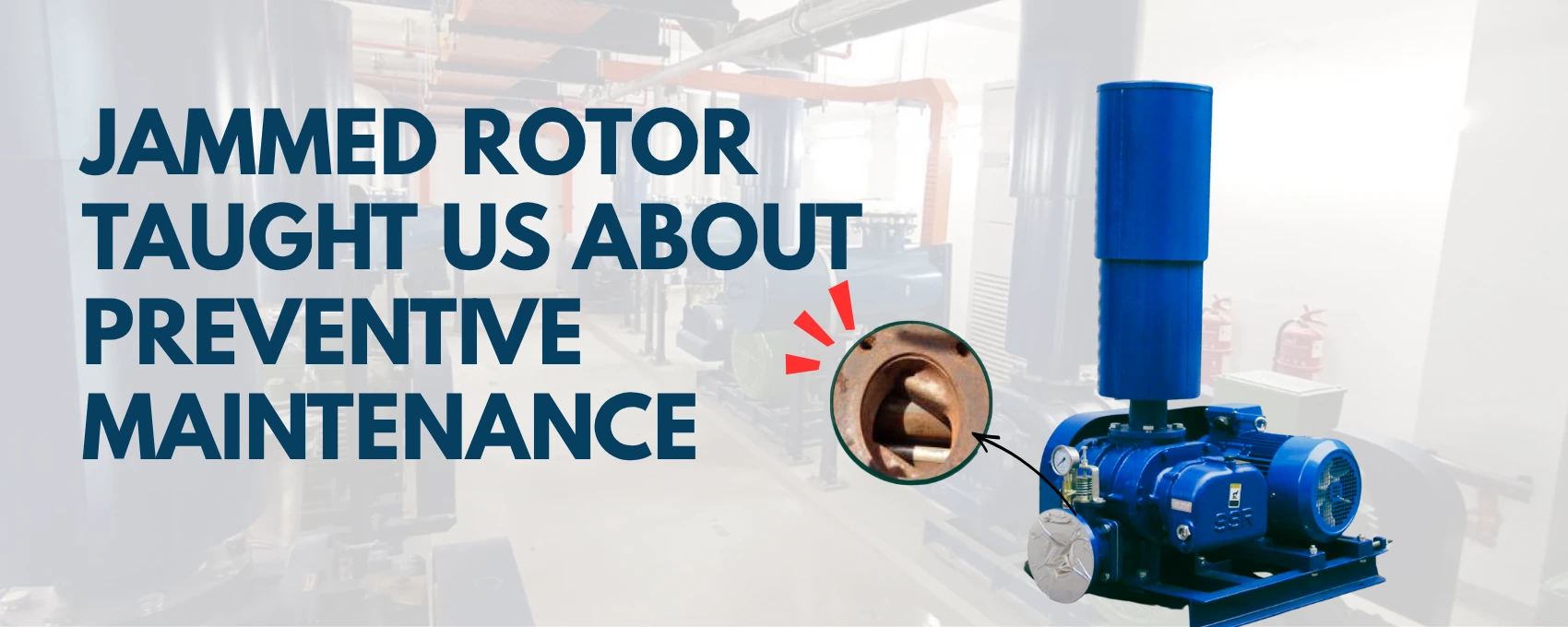
(Images showed above are for illustration purpose)
When an industrial facility called us in with one Roots blower jammed and three others running rough, it turned into a useful lesson for any plant relying on positive displacement blowers for continuous process air. Here’s what we found, what caused it, and what it means for anyone operating similar equipment.
The Situation
The facility was running a bank of four Roots-type blowers (SSR 80 and SSR 50 models) supporting its process operations. One unit had gone completely quiet — jammed solid. The other three were still turning, but the operations team had noticed one of them running noticeably noisier than usual. Our service team was called in to inspect all four units and get to the root of the problem.
What We Found?
On dismantling the jammed unit’s inlet silencer, the rotor damage told the whole story. The rotor surface and bearings were heavily rusted, worn, and physically damaged — consistent with water ingress into the blower housing over an extended period.
Once water gets into a Roots blower housing, the effects compound quickly:
- Corrosion begins on the rotor surface and bearing races.
- Clearances change as rust builds up, since Roots blowers depend on extremely tight rotor-to-housing tolerances to function.
- Running noise increases as the rotors start contacting worn or corroded surfaces.
- Left unaddressed, the rotor eventually seizes — which is exactly what happened here.
The three remaining units hadn’t failed yet, but they were on the same trajectory. Left unchecked, all four blowers were on track to be down for repair — not just one.
Root Cause: Not a Manufacturing Defect — A Maintenance Gap
This is the part worth underlining: the failure wasn’t caused by a faulty part or a design flaw. It was caused by an operating environment issue — water reaching internals that are supposed to stay dry — combined with the absence of a maintenance routine that would have caught it early.
Roots blowers are mechanically simple but intolerant of two things: contamination and neglect. A basic planned preventive maintenance (PPM) schedule would typically catch early signs of moisture ingress — condensation, minor corrosion, or unusual noise — long before a rotor seizes.
What We Recommended?
Our service report gave the facility three straightforward, non-negotiable recommendations:
- Install and operate strictly according to the manufacturer’s manual. Positioning, drainage, ventilation, and inlet protection specifications exist precisely to prevent scenarios like water ingress. Skipping or improvising on installation steps is one of the most common root causes we see in blower failures.
- Implement scheduled PPM, not reactive maintenance. A structured inspection and maintenance audit catches wear, corrosion, and clearance issues while they’re still cheap to fix — long before they become a full rotor replacement.
- Make the operating manual a living reference for site staff, not a document that gets filed away after commissioning. Operators who understand why a step matters (not just that it exists) are far more likely to flag early warning signs.
The Bigger Lesson for Plant Operators?
This case is a fairly common pattern across the industrial blower installations we service: the equipment rarely fails on its own — the maintenance program around it fails first. A few practical takeaways for any facility running Roots blowers or similar rotary equipment:
- Noise is data. A blower running noisier than its neighbors is already telling you something is wrong. Don’t wait for it to stop.
- Moisture is the enemy. Inlet silencers, housing seals, and drainage paths should be part of every routine inspection — not just annual overhauls.
- One unit’s failure is a warning for the whole fleet. If blowers are installed and operated identically, a fault in one is a strong signal to inspect the rest immediately, not just the unit that’s already failed.
- Manuals aren’t paperwork — they’re the maintenance spec. Installation and operating manuals encode the manufacturer’s tolerances and environmental requirements. Deviating from them is almost always where failures start.
How Winston Engineering Helps Prevent This?
As a regional pumping and blower solutions provider, our service teams don’t just repair equipment — we look for the operational root cause behind every service call. For facilities running Roots blowers, submersible pumps, or similar rotating equipment, we offer:
- On-site inspection and rotor/bearing condition assessment
- Structured PPM programs tailored to your operating environment
- Installation audits against manufacturer specifications
- Staff guidance on manual-compliant operation and troubleshooting
If your facility is running blowers or pumps without a formal PPM schedule, this case is a useful reminder of what’s at stake — and how much cheaper it is to prevent than to repair.
Frequently Asked Questions
1.What is water ingress in a Roots blower?
Water ingress refers to water entering the blower housing — the sealed casing around the rotors and bearings — where it isn’t meant to be. It usually gets in through worn seals, damaged inlet silencers, poor drainage, or incorrect installation, and leads to rust, corrosion, and eventually rotor or bearing failure.
2.What are the warning signs of water ingress in a blower?
The earliest sign is usually increased running noise compared to other identical units. Other indicators include visible condensation or moisture near the housing, corrosion streaks, and a gradual drop in performance before the unit eventually seizes.
3.Can a Roots blower still run after water ingress has started?
Yes, often for a while — corrosion and wear develop gradually, so a blower can keep running (typically with rising noise) before it finally jams. That window is exactly when a maintenance inspection can catch and fix the problem cheaply, before it becomes a full rotor or bearing replacement.
4.What is PPM (Planned Preventive Maintenance) and why does it matter for blowers?
PPM is a scheduled inspection and servicing routine, rather than fixing equipment only after it fails. For Roots blowers, PPM catches early signs of moisture ingress, wear, and misalignment while they’re minor issues — well before they cause rotor seizure or unplanned downtime
5.Does water ingress mean the blower was faulty?
No. In most cases, including this one, the blower itself wasn’t defective — the damage came from an installation or environmental issue (like inadequate sealing or drainage) combined with a lack of routine maintenance, not a manufacturing fault.
6.How can water ingress be prevented in industrial blowers?
Following the manufacturer’s installation manual closely (correct positioning, ventilation, drainage, and inlet protection) is the first line of defense. Combined with a regular PPM schedule and periodic inspection of seals and silencers, most water ingress issues can be caught and prevented before they cause damage.
7.If one blower in a fleet shows water ingress damage, should the others be checked too?
Yes. If multiple units are installed and operated under the same conditions, one unit’s failure is a strong signal the others may be developing the same issue. It’s worth inspecting the whole fleet immediately rather than waiting for additional failures.

Author Bio
Javier

Javier is a Marketing Executive at Winston Engineering with a strong foundation in digital marketing, content creation, and SEO. Holding a Bachelor's degree in Marketing from UTAR, he brings a blend of creative and analytical skills to the team, managing everything from social media and Google Ads to video production and website content. Javier's expertise spans Adobe Illustrator, Adobe Premiere Pro, Google Analytics, and CMS platforms, making him a versatile contributor to Winston Engineering's growing digital presence across the region.
See all posts by Javier »