How to Select a Pump for Textile Wastewater Treatment Plants
Bangladesh’s Ready-Made Garment (RMG) sector is the backbone of the national economy and its dyeing, printing, and washing units are also among the country’s largest generators of industrial wastewater. Every effluent treatment plant (ETP) built to handle that wastewater depends on one piece of equipment working reliably around the clock: the pump. Choose the wrong one, and a textile mill risks clogged lines, unplanned downtime, and non-compliance with Bangladesh’s discharge standards. Choose the right one, and the entire treatment process runs smoothly, cost-effectively, and within regulation.
This guide walks through how to select a pump for a textile ETP in Bangladesh — from understanding the problem, to picking the right pump type, to getting expert support from Winston Engineering.
The Problem: Textile Effluent Is Tough on Pumps
Textile wastewater is not like ordinary sewage. Depending on the stage of production — dyeing, printing, washing, or finishing — the effluent can carry:
- Fibrous lint and yarn fragments that wrap around impellers and cause clogging
- High temperatures, sometimes well above ambient, from washing and dyeing baths
- Fluctuating pH, from acidic dye baths to alkaline scouring liquors
- Dissolved and suspended solids, dyes, salts, and surfactants at high concentration
- Variable flow volumes, spiking during production shifts and batch discharges
A pump not designed for these conditions wears out fast. Clogged impellers, seal failures, and motor burnout are common complaints in mills using undersized or general-purpose pumps for ETP duty and every hour of pump downtime is an hour effluent can’t be treated before discharge.
On top of the operational risk, there’s a regulatory one. Bangladesh’s Environmental Conservation Rules (ECR) 2023 which replaced the 1997 rules tightened the discharge standards textile units must meet, including a maximum COD of 200 mg/L, a color limit of 150 Hazen units, and a discharge temperature no more than 5°C above the receiving water body. A pump breakdown that interrupts treatment, even briefly, can mean effluent bypassing the ETP and a mill falling out of compliance.
Why Standard Pumps Fall Short?
Many mills default to whatever pump is cheapest or most familiar, without matching it to the actual duty. The most common mismatches:
- Open or semi-open impellers without non-clog design jam quickly on lint and fibrous solids
- Standard steel or plastic components corrode under the acidic or alkaline conditions of dye effluent
- Undersized motors overheat or trip under the higher viscosity and temperature of raw effluent
- Pumps without adequate ingress protection fail early when installed submerged in sumps or collection tanks
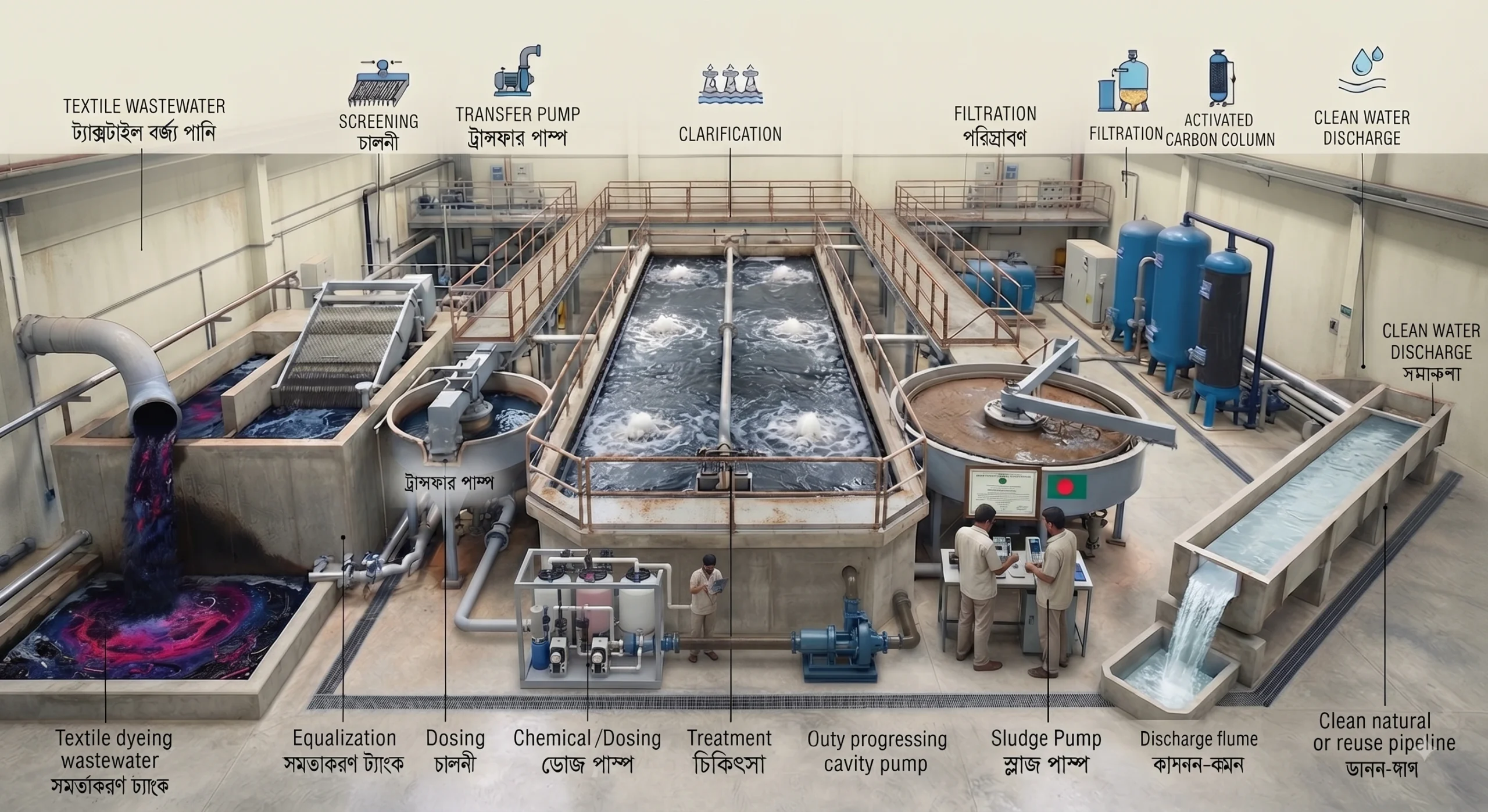
Selecting correctly means matching the pump to the specific stage of the ETP — raw effluent collection, equalization tank transfer, sludge handling, or treated water discharge rather than treating “pump” as a single generic category.
Recommended Pump: Submersible Non-Clog Pumps for Textile ETPs
For the raw and partially treated effluent stages of a textile ETP where fibrous solids and suspended matter are the biggest risk — a submersible non-clog pump is the standard recommendation across the wastewater treatment industry, and it’s the configuration Winston Engineering most often specifies for textile mills in Bangladesh.
Winston Engineering supplies the Fujico B Series submersible pumps for this exact duty. Key features relevant to textile ETP applications:
- Non-clog impeller with an impeller passage of up to 90 mm, letting fibrous lint, yarn, and solids pass through without jamming
- Cast iron construction for the pump body, impeller, and motor housing — built to resist the corrosive and abrasive nature of dyeing and washing effluent
- IP68 protection rating, rated for continuous submerged operation in sumps and collection pits
- Built-in motor protection, with an optional moisture sensor for early fault detection
- Optional float switch control for automatic, unattended operation as effluent levels rise and fall
- Power range from 0.75 kW (1 HP) up to 75 kW (100 HP), with capacity up to 1,250 m³/h and head up to 64 metres — covering everything from a small dyeing unit’s sump to a large composite mill’s main ETP
Selection Guide: 5 Factors to Check Before You Buy
- Flow rate (m³/h): Base this on your mill’s peak effluent discharge, not the average — dye batches and wash cycles often spike volume for short periods, and under sizing here is the most common mistake.
- Total dynamic head (m): Account for the vertical lift from the sump to the next treatment stage, plus friction losses through pipework, valves, and fittings.
- Solids and fiber content: Confirm the impeller passage size is large enough for the lint, yarn waste, and suspended solids typical of your process — this determines clog resistance far more than horsepower does.
- Material compatibility: Match wetted-part materials to your effluent’s pH range and temperature, especially if dye baths run acidic, alkaline, or hot.
- Duty cycle and standby: For continuous ETP operation, plan for duty/standby pump pairs so maintenance or a fault on one unit doesn’t halt treatment and risk a compliance breach.
Winston Engineering Solution
Winston Engineering has supported industrial and municipal wastewater customers across Southeast and South Asia including Bangladesh with pump selection, supply, and after-sales support built around the realities of local operating conditions. For textile ETPs, that means:
- Engineering-led sizing: Our team reviews your effluent flow, head, and composition data before recommending a model — not a one-size-fits-all catalogue pick.
- Genuine Fujico pumps backed by manufacturer documentation and performance curves.
- Local installation and maintenance support, including preventive maintenance programmed to protect uptime and extend pump life.
- Spare parts availability, so a worn impeller or seal doesn’t become a multi-week shutdown.
Get a Pump Recommendation for Your Textile ETP
Every textile mill’s effluent profile is different, and the right pump model depends on your actual flow, head, and effluent characteristics. Send our team your ETP requirements and we’ll recommend the right Fujico B Series configuration for your plant.
Enquire with Winston Engineering today to get expert pump sizing and a formal quotation for your textile wastewater treatment plant in Bangladesh.

Author Bio
Javier

Javier is a Marketing Executive at Winston Engineering with a strong foundation in digital marketing, content creation, and SEO. Holding a Bachelor's degree in Marketing from UTAR, he brings a blend of creative and analytical skills to the team, managing everything from social media and Google Ads to video production and website content. Javier's expertise spans Adobe Illustrator, Adobe Premiere Pro, Google Analytics, and CMS platforms, making him a versatile contributor to Winston Engineering's growing digital presence across the region.
See all posts by Javier »