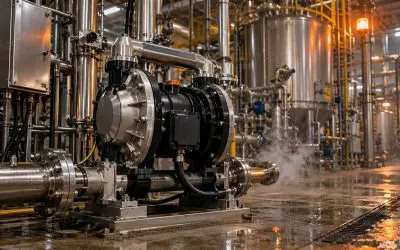
Is the motor running and the pump sounding normal, but no water is flowing? This is a relatively common issue with centrifugal pumps and does not necessarily mean that the pump unit itself is damaged. In many cases, the problem is caused by incomplete priming, air entering the suction line, closed valves, or the motor rotating in the wrong direction.
It is important to remember that a pump should never be allowed to operate continuously without fluid flow, a condition known as dry running. This can cause excessive heat buildup, damage the mechanical seal, and accelerate wear on internal components. Stop the pump immediately if no water flows after start-up.
Before carrying out any physical inspection, make sure the power supply is switched off, system pressure has been safely released, and all applicable workplace safety procedures are followed. Below is an overview of the most common causes and the steps you can take to inspect them.
1. The Pump Casing Is Not Filled with Water (Priming Failure)
Standard centrifugal pumps generally cannot move air effectively. The suction line and pump casing must be completely filled with liquid before the pump is started. This process is known as priming.
If air remains trapped inside the casing, the impeller will simply circulate air without generating sufficient suction to draw water into the pump. Check the priming port and make sure no air remains trapped inside the casing.
2. Air Is Entering Through the Suction Line
The pressure in the suction line is typically below atmospheric pressure. As a result, even small gaps in pipe connections can allow air to enter the system, disrupting the priming process.
Inspect the flanges, gaskets, threaded connections, and suction hoses or pipes for small cracks or leaks that could allow air to enter.
3. The Foot Valve or Check Valve Is Malfunctioning
A foot valve prevents liquid from flowing back toward the water source when the pump is switched off. If the valve leaks or becomes clogged with debris, water can drain from the suction line, causing the pump to lose its prime.
Check that the valve opens and closes properly, and ensure that the foot valve remains submerged in water during operation.
4. The Suction Pipe or Strainer Is Clogged
Debris such as algae, plastic, leaves, or scale can obstruct the strainer and suction pipe, restricting water flow.
Remove and clean the strainer regularly. Also, make sure the strainer mesh size is appropriate for the application, as a mesh that is too fine can unnecessarily restrict fluid flow.
5. The Valve Position Is Incorrect
One simple cause that is often overlooked is a valve that is partially or completely closed.
Make sure the suction-side valve is fully open before operating the pump. Restricted suction flow can cause excessively low inlet pressure and increase the risk of cavitation.
6. The Motor Is Rotating in the Wrong Direction
Incorrect motor rotation commonly occurs after a new installation, motor replacement, or electrical maintenance.
Although the impeller may still rotate, pump performance can drop significantly, preventing the pump from delivering water as expected. Always compare the motor’s direction of rotation with the directional arrow on the pump casing or nameplate.
7. The Suction Lift Is Too High
Every pump has limits on its vertical suction lift capability. If the water source is too far below the pump, the suction pipe is too long, or the piping contains too many bends or elbows, the pump may not be able to achieve sufficient suction pressure.
Possible solutions include moving the pump closer to the water source or increasing the diameter of the suction pipe to reduce friction losses.
8. The Impeller Is Clogged or Damaged
Foreign objects or hard solids entering the pump can clog or damage the impeller blades, reducing pumping performance or preventing water from flowing.
For product lines such as the Euroflo End Suction Centrifugal Pump, maintenance can be simplified by the back pull-out design. This allows the rotating assembly to be removed without dismantling the entire surrounding pipework.
9. The System Head Is Too High
If the pump was previously operating normally but the flow suddenly stops, check whether any changes have been made to the piping system. Examples include an extended discharge line or a partially closed valve.
Make sure the pump can provide sufficient head to overcome the total system resistance under actual operating conditions.
Conclusion
A centrifugal pump that fails to deliver water does not necessarily have a major mechanical fault. Common causes include priming failure, air entering the suction line, malfunctioning valves, a clogged suction line, incorrect motor rotation, or system head requirements that exceed the pump’s capabilities.
If basic troubleshooting does not identify the cause, avoid repeatedly restarting the pump, as this can increase the risk of component damage.
For water transfer and industrial pumping applications, the Euroflo End Suction Centrifugal Pump is one solution worth considering. Its back pull-out design also simplifies maintenance by allowing the rotating assembly to be accessed without dismantling the entire piping system.
Winston Indonesia provides centrifugal pumps and a range of pumping equipment for industrial applications. Consult the Winston Indonesia team about your fluid characteristics, flow rate, head requirements, and installation conditions to identify a suitable solution for your application. For more information and technical consultation, please Contact Us to discuss your requirements with our team.

Author Bio
Rian

Team PT Winston technically driven member of PT Winston Indonesia with strong practical knowledge of pumps and fluid handling solutions. We work closely with customers to understand their operating requirements, recommend suitable pump solutions, and introduce products that can improve reliability, efficiency, and overall system performance. With a hands-on and solution-oriented approach, We help bridge technical requirements with practical product selection, ensuring customers receive the right pumping solution for their applications.
See all posts by Rian »