
(Images showed above are for illustration purpose)
A pump that continues running with low discharge pressure needs a closer investigation. In this service case, Winston Engineering’s Malaysia team inspected a Fybroc 4X6X13 pump following a complaint of no discharge pressure. On-site checks confirmed low pressure, and further investigation identified erosion and an impeller-to-housing clearance outside the acceptable range.
The problem reported
The customer reported that the pump had no discharge pressure. During the site visit, our technical team found that the pump was running with low pressure. This distinction matters: the reported symptom prompted the visit, while the operating condition observed on site guided the investigation.
What the inspection found?
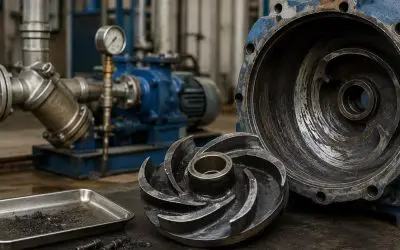
The team dismantled the pump on site to inspect its internal components. The initial inspection entry described the parts, including the impeller and casing, as being in good condition. However, the subsequent investigation recorded erosion of the impeller and housing, with the distance between them outside the acceptable range.
The report attributed the low discharge pressure to this condition. The difference between the initial observation and the later finding is a useful maintenance lesson: an initial condition check alone may not establish whether internal clearances remain suitable for operation.
For this pump, checking the impeller-to-housing clearance was a key part of identifying the issue.
The recommended service approach
The service report identified three areas for follow-up.
1. Check and correct the impeller-to-housing clearance. The first recommendation refers to checking, measuring and resetting the distance between these components. Any adjustment should follow the applicable manufacturer’s instructions.
2. Carry out testing and a maintenance audit. The report called for pump testing and commissioning, a maintenance audit, and checks described as water quality, level and PPM. It did not identify the substance or parameter to be measured in PPM, or give a target value. Those details would need to be established for the actual application.
3. Follow the operating manual. The team advised the user to operate the pump according to its manual. Operating requirements should be considered alongside component condition when planning further servicing.
What the case demonstrates?
The practical value of the case is its diagnostic process: confirm the symptom on site, inspect the pump internally, check relevant clearances and define the follow-up work. This gives maintenance teams a clearer basis for deciding what further adjustment, repair or testing is needed.
What maintenance teams can take from this case?
When requesting support for a pump with low discharge pressure, provide the pump model, the normal and current pressure readings if available, the fluid being handled and any recent changes in operation. These details help the service team understand the problem before inspection.
Keep inspection findings, measurements, service actions and post-service test results together in the maintenance record. In this case, the missing final test results limit what can be concluded about recovery. A documented follow-up test would provide stronger evidence of the pump’s condition after servicing.
Pump maintenance and repair support from Winston Engineering
Winston Engineering provides pump inspection, servicing, repair and maintenance support. Its service offering includes diagnostics, pump overhauls, mechanical seal replacement and reassembly, with on-site or workshop work selected according to the service requirements.
This case illustrates the role of inspection in defining the work a pump needs. If your pump is running with low discharge pressure, contact Winston Engineering to discuss an assessment and the appropriate next steps for your equipment.
For Singapore enquiries: Singapore team
For Malaysia enquiries: Malaysia team
Send your pump model, symptoms, available operating readings and site location to help the team assess your servicing requirements.

Author Bio
Javier

Javier is a Marketing Executive at Winston Engineering with a strong foundation in digital marketing, content creation, and SEO. Holding a Bachelor's degree in Marketing from UTAR, he brings a blend of creative and analytical skills to the team, managing everything from social media and Google Ads to video production and website content. Javier's expertise spans Adobe Illustrator, Adobe Premiere Pro, Google Analytics, and CMS platforms, making him a versatile contributor to Winston Engineering's growing digital presence across the region.
See all posts by Javier »