Industrial coating projects require consistent coverage, efficient application and reliable equipment to achieve quality results. Whether applying protective coatings, epoxy or industrial paints, choosing the right spraying equipment can make a significant difference to project efficiency.
An airless sprayer is a popular solution for professional contractors and industrial coating applications. Unlike conventional spray equipment that uses compressed air to atomise paint, an airless sprayer uses high pressure to force coating materials through a small spray tip, producing a fine and even spray pattern.
Here are five key benefits of using an airless sprayer for industrial coating applications.
1. Faster Application and Improved Productivity
One of the main advantages of an airless sprayer is its ability to cover large surface areas quickly. Compared with traditional brush and roller application, airless spraying can significantly reduce application time, particularly for large industrial surfaces.
This makes it suitable for contractors handling warehouses, factories, steel structures and other large-scale coating projects.
2. Consistent and Even Coating Coverage
Achieving uniform coating thickness is important for industrial applications. An airless sprayer produces a controlled spray pattern that helps distribute coating materials evenly across surfaces.
With proper pressure settings, spray tip selection and application techniques, contractors can achieve a smoother finish and more consistent coverage.
3. Suitable for Various Coating Materials
Airless sprayers can handle a wide range of coating materials, depending on the equipment specifications and spray tip compatibility.
Common applications include:
- Industrial paints and primers
- Protective coatings
- Epoxy coatings
- Waterproofing materials
- High-build coatings
For thicker or higher-viscosity materials, selecting a suitable airless sprayer with sufficient pressure and flow capacity is essential.
4. Reduced Manual Effort
Using an airless sprayer reduces the need for repetitive brushing and rolling, making coating applications more efficient.
It is particularly useful for large surfaces, difficult-to-reach areas and projects with tight completion schedules. Contractors can spend less time on manual application and focus more on achieving the required coating quality.
5. Versatile for Different Industrial Applications
Airless sprayers are used across various industries and project environments. Depending on the model and material compatibility, they can support applications such as:
- Building and construction
- Industrial maintenance
- Steel structure protection
- Waterproofing projects
- Commercial and residential painting
This versatility makes airless spraying equipment a practical investment for professional painting and coating contractors.
How to Choose the Right Airless Sprayer
Before selecting an airless sprayer, consider the following factors:
- Maximum working pressure: Ensure the sprayer can support the pressure requirements of your coating material.
- Flow rate: Choose a suitable flow capacity based on project size and application requirements.
- Maximum tip size: Check that the machine supports the spray tip required for your coating.
- Material compatibility: Confirm that the pump, hose and other wetted components are suitable for the material.
- Maintenance and durability: Consider pump servicing, replacement parts and long-term operating requirements.
Selecting the right equipment helps improve application efficiency and supports consistent project results.
Explore Graco Airless Sprayers from Winston
Choosing reliable spraying equipment is important for achieving efficient and consistent coating applications. Graco offers a range of professional airless sprayers designed for different painting and industrial coating requirements.
Winston provides Graco spraying solutions, including:
- Graco Mark HP XT: Designed for demanding high-pressure protective coating applications.
- Graco Ultra 695 XT (19F712): A professional electric airless sprayer for medium to large painting and coating projects.
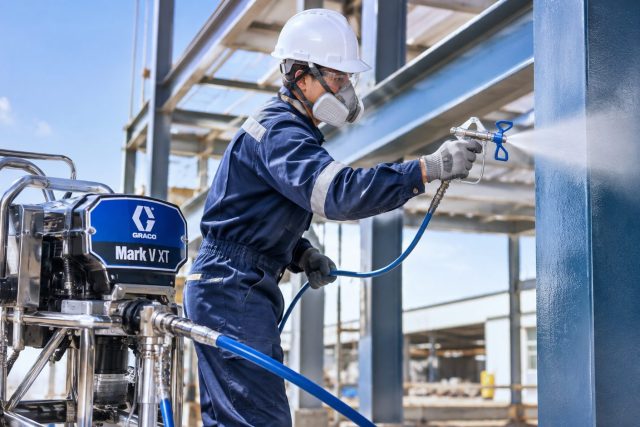
- Graco Mark V XT ProContractor (19F724): Features enhanced pump technology and productivity-focused features for professional contractors.
Explore Winston’s range of Graco airless sprayers to find suitable equipment for your coating and painting applications.
Contact Winston Engineering to learn more about our Graco spraying solutions.
Frequently Asked Questions (FAQs)
1. Can an airless sprayer handle thick industrial coatings?
Yes, selected airless sprayer models can handle high-viscosity materials and heavy-duty coatings. However, the required pressure, flow rate, maximum tip size and material compatibility should be considered before choosing a machine.
2. How do I choose the right airless sprayer for industrial coating?
Consider the type of coating material, project size, required working pressure, flow rate and maximum spray tip size. For demanding applications, choose a professional sprayer designed to handle the specific coating requirements.
3. Which Graco airless sprayer is suitable for industrial coating applications?
Graco offers different airless sprayer models for various coating requirements. The Mark HP XT is designed for demanding high-pressure applications, while the Ultra 695 XT and Mark V XT ProContractor are professional electric sprayers suited to different painting and coating requirements. The final selection depends on the coating material and project specifications.
4. What is an airless sprayer used for?
An airless sprayer is used to apply paints, primers, protective coatings and other compatible coating materials onto surfaces. It is commonly used in industrial, commercial and residential painting projects where efficient application and consistent coverage are required.
5. What is the difference between an airless sprayer and a traditional paint sprayer?
An airless sprayer uses high pressure to atomise coating material through a spray tip, while conventional air spray equipment uses compressed air. Airless sprayers are commonly preferred for larger surfaces and applications requiring higher material output.

Author Bio
Chun Wei

Chun Wei is a marketing professional with a Bachelor of Arts in Marketing from UCSI University. With hands-on experience spanning social media management, data analysis, and sales marketing, he brings a fresh and analytical perspective to content and digital strategy. His background across various industries has sharpened his ability to translate insights into effective marketing initiatives. At Winston Engineering, Chun Wei contributes to the team's mission of putting solutions in action through clear, engaging, and informative content.
See all posts by Chun Wei »