If you run an effluent treatment plant (ETP) in Bangladesh, the aeration tank is where most of your treatment actually happens. The bugs in the tank need oxygen, and that oxygen comes from air your blower pushes through the diffusers. When the blower is wrong for the job, you feel it in two places: the lab results, and the electricity bill.
This article walks through how roots blowers are used in wastewater treatment, what to look at before you buy one, and where the Taiko blower range from Winston Engineering fits in.
Why aeration decides so much of your plant’s running cost?
In secondary treatment, air is supplied so the microorganisms can break down organic matter and bring BOD and COD down. A technical brief from the UNCTAD-backed SMEP programme on a textile wastewater pilot in Bangladesh notes that aeration is among the most energy-intensive steps, accounting for roughly 50 to 60% of a treatment plant’s total energy demand.
So the blower is not a side item. It is usually the biggest single electrical load in the plant. A unit that is oversized wastes power every hour it runs. One that is undersized leaves the tank short of oxygen, and that is when effluent starts failing the limits set under Bangladesh’s Environment Conservation Rules.
Why roots blowers are so common in ETPs and STPs?
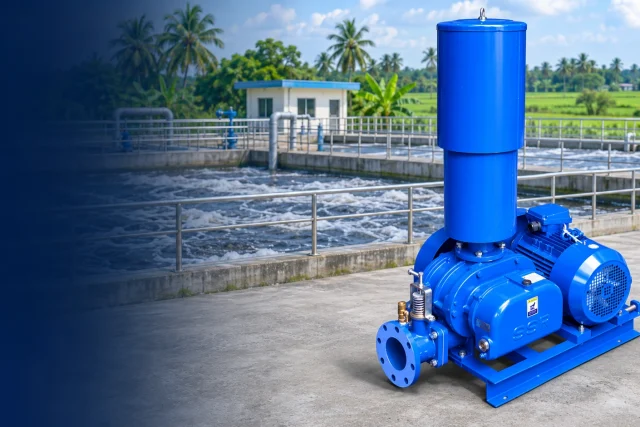
A roots blower is a positive displacement machine. Two or three lobed rotors turn inside a casing and trap a fixed volume of air with each rotation, then push it out the discharge side. That gives you a few practical advantages in a wastewater plant:
- Steady airflow. The volume stays fairly constant even when discharge pressure moves around, which happens as diffusers foul or water level changes.
- Simple, rugged construction. Fewer things to go wrong on a plant that runs around the clock.
- Easy to match to the tank. Capacity and pressure ranges are wide enough to cover everything from a small package plant to a large textile ETP.
- Oil-free air. Important when the air goes straight into the biology.
Roots blowers are used well beyond wastewater, in pneumatic conveying, aquaculture, cement and chemical plants. Textile industries and sewage treatment plants are two of the most common applications, and both are everywhere in Bangladesh.
Where you will see them in Bangladesh?
Mostly in three places. Garment and dyeing factories need ETPs to meet discharge standards and buyer requirements. Industrial parks and EPZs often run shared or centralised treatment. And municipal and housing sewage plants use them for aeration tanks too. The factory setups vary a lot, but the same question comes up every time: how much air, at what pressure, for how many hours a day?
What to check before choosing a roots blower?
Don’t start with the model number. Start with the tank.
- Air demand. Your process designer or ETP contractor should give you the required air volume in m³/min. Ask for the figure at actual site conditions, not just at standard conditions.
- Discharge pressure. A rule of thumb: every meter of water above the diffuser adds about 9.8 kPa. Add diffuser losses, piping losses and a margin for fouling. Pressure that looks fine on paper at commissioning can be tight two years later.
- Temperature. Bangladesh summers are hot and humid, and intake air temperature affects both airflow and motor loading. Check the ratings against your real ambient, not a brochure figure.
- Motor and drive. If the oxygen demand swings through the day (it usually does in textile plants), think about a variable speed drive, or a duty/standby arrangement, so you are not running flat out all night.
- Noise. Blowers near offices or housing need an enclosure or silencer. Plan for it early. Retrofitting is annoying.
- Spares and service. A blower that stops is a plant that can fail compliance. Ask who holds spare parts, and how fast someone can actually get to you.
Taiko roots blowers from Winston Engineering
Winston Engineering supplies Taiko roots blowers and vacuum pumps. For wastewater aeration, two series are worth knowing.
Taiko SSR (3-lobe roots blower). This is the one most ETP projects will look at first. Per the product page, the SSR range covers air capacities from 0.8 to 56 m³/min and pressures from 0.1 to 0.6 kgf/cm² (about 10 to 59 kPa). The three-lobe design is chosen for smoother delivery and lower noise, which suits plants that run continuously. You can see it on the Taiko 3-lobe roots blower page.
Taiko SSR-T (2-lobe roots blower/vacuum pump). Aimed at smaller flows. Application such as wastewater aeration, fish care, back washing and vacuum packing as typical uses, which makes it a good fit for small package plants, pilot lines and aquaculture. Details are on the Taiko 2-lobe roots blower page.
If you want the whole range in one place, the Taiko brand page has it, and the air blower category shows Taiko next to the other blower types Winston Engineering carries, including side channel blowers and magnetic levitation centrifugal blowers for larger plants.
One honest note: published ranges are a starting point. The right model depends on your actual air volume, pressure and site conditions, so confirm duty points with the Winston Engineering team before ordering.
More than just the blower
Winston Engineering works on a supply, service, integration, test and training basis, so you are not left to figure out installation and upkeep on your own. For Bangladesh buyers, the practical benefit is having one supplier who can look at the whole air system: blower, motor, piping and controls. The team can review your operating requirements and point you to a suitable model.
You can see what Winston offers for the Bangladesh market, including pumps, vacuum pumps, blowers and motors for water and wastewater treatment, textile and garment manufacturing and other industries, on the Winston Engineering Bangladesh page.
Talk to us about your plant
Planning a new ETP or replacing blowers on an existing one? Send us your air volume, pressure and tank depth, and the Winston team will suggest a Taiko roots blower that fits. Contact Winston Engineering or start from the Bangladesh page.
Frequently asked questions (FAQ)
1. What size roots blower do I need for an ETP aeration tank?
It comes from two numbers: the air volume the process needs and the pressure the blower has to work against (water depth, plus diffuser and pipe losses). Your ETP designer should supply both. Share them with a supplier and they can match a model.
2. Is a roots blower better than a centrifugal or turbo blower for wastewater?
Not always. Roots blowers suit small to mid-size plants and steady duty. For larger plants where energy use matters most, a high-speed or magnetic levitation centrifugal blower can be worth comparing. It is a project-by-project call.
3. Can a Taiko blower be used for both pressure and vacuum?
The Taiko SST-T is listed as a blower/vacuum pump, so yes, it covers both pressure and vacuum duty. Check the specific model for your duty.
4. Does Winston Engineering supply to Bangladesh?
See the Bangladesh page for the product range, or send an enquiry through the contact page.
5. What causes pumps to fail early?
The usual causes are the wrong pump type for the liquid, cavitation from poor suction conditions, dry running, worn or incompatible seals, and lack of routine checks.

Author Bio
Javier

Javier is a Marketing Executive at Winston Engineering with a strong foundation in digital marketing, content creation, and SEO. Holding a Bachelor's degree in Marketing from UTAR, he brings a blend of creative and analytical skills to the team, managing everything from social media and Google Ads to video production and website content. Javier's expertise spans Adobe Illustrator, Adobe Premiere Pro, Google Analytics, and CMS platforms, making him a versatile contributor to Winston Engineering's growing digital presence across the region.
See all posts by Javier »