Vacuum Pump Guide
When Should You Choose an Oil-Lubricated Rotary Vane Vacuum Pump?
A practical guide for buyers in Singapore comparing rotary pump applications, vapour load, vacuum level, and when an oil-lubricated rotary vane vacuum pump makes sense.
Written by: Winston Engineering Marketing Team
Technical review: Mr.Ng & Team, Micro-Air (Winston Engineering Group of Company)
How this guide was prepared: This article was prepared using current Winston Engineering product information, manufacturer specifications for oil-lubricated rotary vane vacuum pumps, and practical maintenance considerations commonly reviewed during vacuum pump troubleshooting and service assessments.
If you are searching for a rotary pump in Singapore, the first issue is that the term is often too broad. In many cases, buyers are not looking for just any rotary pump — they are trying to determine whether a rotary vane vacuum pump is the right fit for their process.
That distinction matters because not every vacuum application should use the same pump type. The right choice depends on vacuum level, vapour load, duty cycle, cleanliness requirements, and long-term serviceability.
Looking for a rotary pump in Singapore?
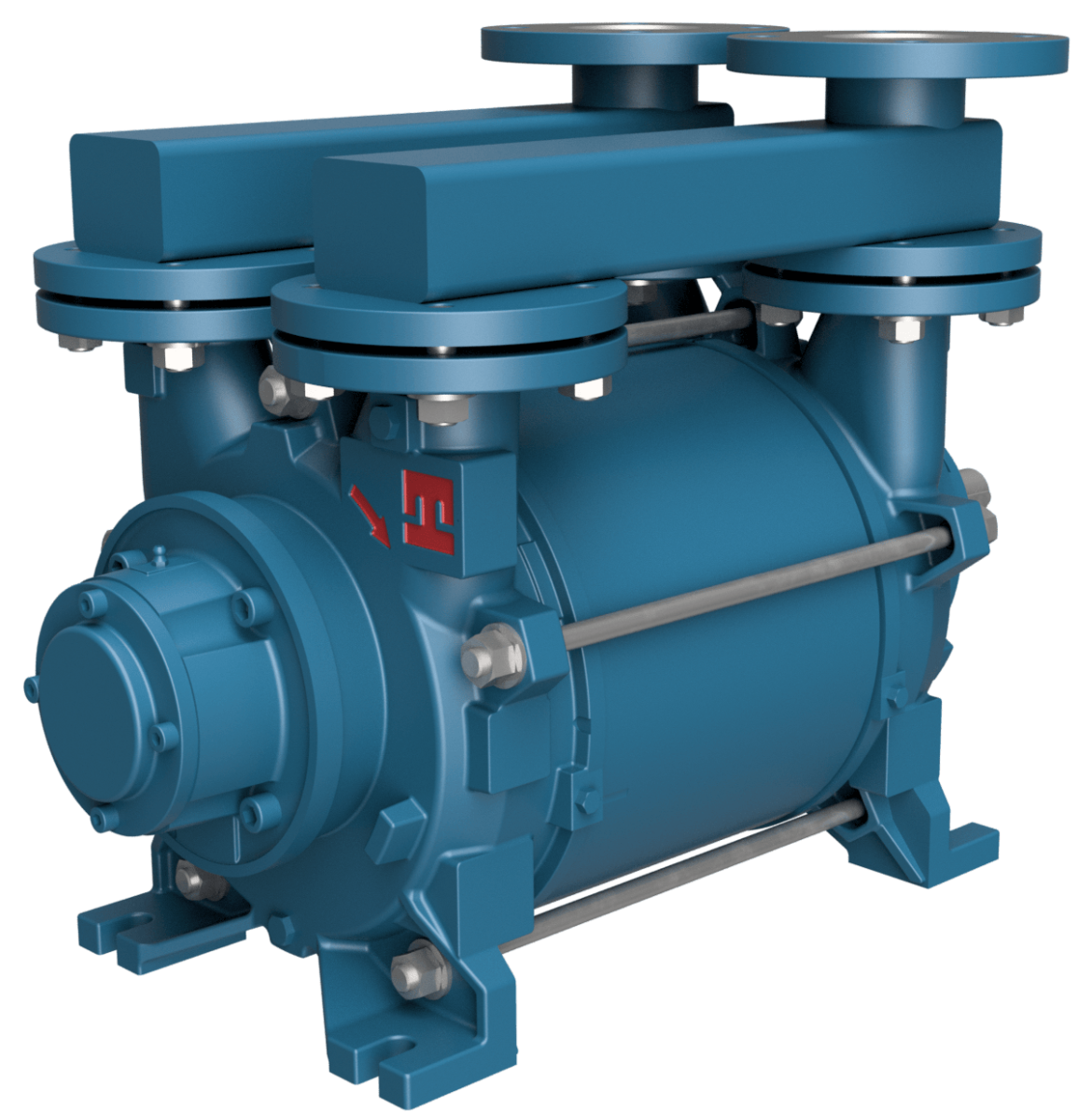
Explore the DVP LC rotary vane vacuum pump range for industrial applications requiring reliable vacuum performance.
View Rotary Pump Product PageWhat is an oil-lubricated rotary vane vacuum pump?
An oil-lubricated rotary vane vacuum pump uses an off-centre rotor and sliding vanes to create expanding and compressing chambers that draw gas into the pump and discharge it through the exhaust.
The oil inside the pump helps perform several functions at once:
- Improves internal sealing
- Reduces leakage
- Supports lower final pressure
- Helps manage friction and heat
This is one reason why oil-lubricated rotary vane technology remains widely used for industrial vacuum duties where stronger vacuum performance is needed.
When is a rotary vane vacuum pump the right choice?
1. When you need better final pressure
If your application requires a finer vacuum or lower final pressure, an oil-lubricated rotary vane vacuum pump is often the better choice compared with dry-running oil-free alternatives.
2. When vapour handling matters
In some industrial processes, the intake flow may contain moisture or vapour. Under the right operating conditions, lubricated rotary vane pumps can be better suited than oil-free designs for these duties.
3. When continuous industrial duty is required
These pumps are commonly selected for demanding day-to-day operation because they are compact, proven, and serviceable in industrial environments.
4. When the application suits the technology
Oil-lubricated rotary vane vacuum pumps are commonly considered for:
- Vacuum packaging
- Food processing
- Dental equipment
- CNC marble and glass machinery
- Precious metal casting
- Printing and paper handling
- Vacuum lifting systems
- Workshop equipment
- Laboratory and filtration duties
When not to choose an oil-lubricated rotary vane pump
Not every vacuum problem should be solved with this technology.
If your process needs clean, low-maintenance, oil-free operation and low-to-medium vacuum is sufficient, an oil-free vane pump may be the better fit.
If the process is genuinely wet, dirty, or chemically aggressive, it is better to compare the broader vacuum pump range than to force-fit a standard rotary vane solution into the wrong application.
Standard LC, WR, or HV?
When comparing models in the DVP LC range, the selection logic should always start with the process.
- Standard LC models are typically the starting point for general industrial vacuum duties.
- WR models should be considered when water vapour load is a real concern.
- HV variants may be reviewed when higher-vacuum requirements apply in larger-capacity systems.
Quick selection rule
Do not choose based on the word “rotary pump” alone. Choose based on vacuum level, gas condition, moisture content, operating hours, and service expectations.
5 questions to answer before choosing a rotary pump
- What vacuum level do you actually need?
- What pumping speed is required?
- Is the gas stream dry, or does it contain vapour or moisture?
- Will the pump run intermittently or continuously?
- What is the repair and maintenance plan if performance declines?
Repair or replace?
If there is already a pump on site, replacement is not always the first answer. In many cases, repair or overhaul may restore performance and extend service life.
If your pump is showing reduced vacuum, slower pump-down, overheating, abnormal noise, vibration, oil leakage, or unstable performance, it may be time to review both the application fit and the service condition of the unit.
Learn more about vacuum pump repair and when servicing may be more economical than replacement.
Final takeaway
“Rotary pump” is too broad to be a useful buying term on its own.
In industrial vacuum applications, the more important question is whether an oil-lubricated rotary vane vacuum pump matches the required vacuum level, vapour load, duty cycle, cleanliness requirement, and service strategy.
If the process needs stronger vacuum performance, some moisture tolerance, and proven industrial-duty operation, this technology is often the right place to start.
FAQ
What is the difference between a rotary pump and a rotary vane vacuum pump?
A rotary pump is a broad engineering term for a positive-displacement pump that uses rotating elements to move liquid, air or gas. Depending on the design, a rotary pump may refer to a rotary vane pump, gear pump, screw pump, lobe pump or hand rotary pump.
A rotary vane vacuum pump is a more specific type of rotary pump designed to generate vacuum. It uses an off-centre rotor with sliding vanes to create expanding and contracting chambers inside the pump. As the rotor turns, gas is drawn into the inlet, compressed, and discharged through the exhaust.
This distinction is important because customers searching for “rotary pump” may not always be looking for the same product. Some may need a hand rotary pump for liquid transfer, while others may need an industrial rotary vane vacuum pump for packaging, printing, CNC, laboratory or process applications.
When should I choose an oil-lubricated rotary vane vacuum pump?
An oil-lubricated rotary vane vacuum pump is usually suitable when the application requires a stable vacuum level, continuous duty operation, and better final pressure than a basic dry-running pump can normally achieve.
The oil inside the pump is not just for lubrication. It also helps seal internal clearances, reduce gas leakage, manage friction, dissipate heat and support lower ultimate pressure. This makes oil-lubricated rotary vane pumps suitable for industrial vacuum duties where performance consistency is more important than having an oil-free design.
Typical applications include vacuum packaging, printing presses, vacuum hold-down, CNC routing, glass and marble machinery, laboratory filtration, vacuum lifting, degassing and general industrial vacuum processes.
When should I not use an oil-lubricated rotary vane vacuum pump?
You should avoid using a standard oil-lubricated rotary vane vacuum pump if the gas stream contains heavy liquid carryover, abrasive dust, corrosive vapour, aggressive chemicals or explosive gases. These conditions can contaminate the oil, damage the vanes, reduce vacuum performance and shorten pump life.
For wet or chemically aggressive applications, a different vacuum technology may be more suitable, such as a liquid ring vacuum pump, dry claw vacuum pump, side channel blower or an engineered vacuum system with proper filtration and condensate handling.
This is why pump selection should not be based only on the keyword “rotary pump”. The correct selection depends on vacuum level, gas composition, vapour load, duty cycle, installation environment and maintenance expectations.
What is the difference between LC, WR and HV rotary vane vacuum pump models?
The correct model depends on the process condition.
A standard LC oil-lubricated rotary vane vacuum pump is usually considered for general industrial vacuum applications where the gas stream is relatively dry and the operating condition is stable.
A WR model should be considered when the process contains meaningful water vapour or moisture. In these applications, vapour handling becomes important because condensation inside the pump can contaminate the oil and affect vacuum performance.
An HV variant may be reviewed when the system requires a higher vacuum level or a larger-capacity configuration. However, model selection should still be based on actual operating data, not only catalogue naming. The key information to confirm includes required vacuum level, pumping speed, operating pressure range, vapour load, inlet condition, operating hours and maintenance access.
How do I size a rotary vane vacuum pump correctly?
Sizing should start with the process requirement, not the motor power or connection size. The most important parameters are:
Required vacuum level
This determines whether a rotary vane vacuum pump is suitable and whether a standard, WR or higher-vacuum variant should be considered.
Required pumping speed
The pump must remove enough air or gas to achieve the desired pump-down time and maintain the working vacuum during operation.
System volume
A larger chamber or longer pipework requires more time to evacuate, so the pump capacity must match the actual system volume.
Leak rate
A system with air leakage may never reach the expected vacuum level, even if the pump is correctly sized.
Gas or vapour condition
Moisture, solvents, oil mist, dust and condensate can affect pump selection and protection requirements.
Duty cycle
Continuous operation requires more attention to oil condition, cooling, exhaust treatment and maintenance intervals.
A common mistake is replacing an old pump based only on the inlet size or kW rating. That may result in poor pump-down time, overheating, oil contamination or premature wear.
Why does vapour load matter in rotary vane vacuum pump selection?
Vapour load matters because moisture or condensable vapour can enter the pump and mix with the oil. Once the oil becomes contaminated, the pump may lose sealing efficiency, run hotter, produce unstable vacuum, or suffer from internal corrosion and wear.
For applications with vapour, the system should be reviewed carefully. A WR model, gas ballast operation, inlet filter, condensate trap, correct warm-up procedure or alternative pump technology may be required.
In engineering terms, the issue is not only whether the pump can “run”. The real question is whether the pump can maintain stable performance under the actual vapour load without excessive oil degradation, maintenance frequency or downtime.
Is an oil-free rotary vane pump better than an oil-lubricated rotary vane pump?
Not necessarily. Oil-free and oil-lubricated designs serve different requirements.
An oil-free rotary vane pump is suitable when the process needs cleaner discharge air, lower oil maintenance and operation in a dry, low-to-medium vacuum application. It is commonly considered for clean handling, light-duty vacuum or applications where oil contamination is undesirable.
An oil-lubricated rotary vane vacuum pump is often preferred when stronger vacuum performance, better sealing and more stable final pressure are required. However, it requires oil monitoring, oil change, exhaust management and proper maintenance.
So the better question is not “which is better?” The better question is: Which pump design matches the required vacuum level, cleanliness requirement, vapour condition and maintenance strategy?
What are the signs that a rotary vane vacuum pump is undersized or wrongly selected?
A wrongly selected pump may still operate, but the system performance will not be stable. Common signs include:
– Long pump-down time
– Vacuum level cannot reach the required setpoint
– Pump runs continuously without stabilising
– Pump overheats during normal operation
– Frequent oil contamination
– Excessive exhaust mist
– Abnormal noise or vibration
– Repeated vane wear
– Poor performance after servicing
– Customer keeps increasing pump size without solving the root cause
If these symptoms appear, the issue may not be the pump alone. The full system should be checked, including pipe sizing, leakage, filters, inlet restriction, vapour load, exhaust back pressure, operating temperature and maintenance condition.
Can a rotary vane vacuum pump be repaired instead of replaced?
Yes, in many cases a rotary vane vacuum pump can be repaired or overhauled if the main body, rotor and key internal components are still serviceable. Repair may be suitable when the pump has reduced vacuum performance, oil leakage, worn vanes, damaged seals, bearing noise, overheating or slow pump-down.
However, replacement may be more practical if the pump is severely worn, badly corroded, repeatedly failing, wrongly selected for the application, or if repair cost is too close to the cost of a new pump.
For industrial users in Singapore, the decision should consider more than repair cost alone. Downtime, spare parts availability, energy usage, reliability, maintenance history and future operating conditions should also be reviewed.
What maintenance is required for an oil-lubricated rotary vane vacuum pump?
Maintenance usually includes regular oil inspection, oil change, exhaust filter replacement, inlet filter cleaning, leak inspection and checking for abnormal noise, temperature or vibration.
The oil condition is especially important. Contaminated or degraded oil can reduce sealing efficiency, increase wear, cause overheating and affect ultimate vacuum pressure. If the pump operates in a dusty, wet or high-vapour environment, the maintenance interval may need to be shortened.
A good maintenance plan should include:
– Checking oil level and oil colour
– Replacing oil based on operating condition
– Inspecting exhaust mist filter
– Cleaning or replacing inlet filter
– Checking for blocked ventilation
– Inspecting coupling, belts or motor condition where applicable
– Recording vacuum level and pump-down time over time
Instead of waiting for pump failure, users should track performance trends. A gradual drop in vacuum level or longer pump-down time is often an early warning sign.
What information should I provide before requesting a rotary pump recommendation?
To recommend the correct rotary vane vacuum pump, the supplier should know the actual operating condition, not just the brand or model number of the old pump.
Useful information includes:
– Current pump model and nameplate
– Required vacuum level
– Required pumping speed or pump-down time
– Chamber size or system volume
– Application type
– Gas condition: dry, wet, dusty, oily or chemical vapour
– Operating hours per day
– Continuous or intermittent duty
– Inlet and outlet connection size
– Existing problem, such as overheating, slow vacuum or oil mist
– Whether the requirement is new installation, replacement or repair
This information helps avoid oversizing, undersizing or selecting a pump that cannot handle the actual process condition.
About Winston Engineering
Winston Engineering supplies industrial pump and vacuum solutions in Singapore, supporting customers with product selection, system recommendations, and service support across a range of applications.
Need help selecting a rotary pump in Singapore?
Share your existing pump model, required vacuum level, application details and operating condition with Winston Engineering. Our team can help review whether a DVP rotary vane vacuum pump, oil-free vane pump, repair option or alternative vacuum solution is more suitable for your application.

Author Bio
Andrew

Andrew is a seasoned marketing professional with over 14 years of experience at Winston Engineering, where he has grown from Marketing Executive to Marketing Manager. With a deep understanding of the industrial and engineering sector, he specialises in brand development, digital transformation, and content strategy. Andrew's expertise spans social media marketing, web content, advertising, and corporate events, making him a key voice in communicating Winston Engineering's solutions to audiences across the region.
See all posts by Andrew »