In the Oil & Gas industry, the transfer of petroleum products is an essential part of daily operations. This process involves transferring fuel from storage tanks to tank trucks, distribution facilities, production areas, and various industrial equipment.
Although they all originate from petroleum products, diesel, gasoline, kerosene, fuel oil, and lubricants have different characteristics. Differences in viscosity, temperature, and contaminant content can affect pump performance. If the pump type is not suitable for the application, the transfer process may become less efficient, the required capacity may not be achieved, and components may even be damaged.
Therefore, selecting a petroleum pump requires consideration of the fluid type, flow rate requirements, pressure, suction conditions, and the appropriate drive system for the installation.
Identify the Type of Petroleum Product Being Transferred
Each petroleum product has different characteristics and therefore requires specific technical considerations.
Some of the common fluids handled in the oil and gas industry include:
- Diesel and gasoline: Relatively low-viscosity fuels that can generally be transferred using centrifugal pumps with the appropriate configuration.
- Kerosene and aircraft fuel: Require pumps with materials and sealing systems compatible with the fluid and the application’s safety requirements.
- Fuel oil: Its characteristics depend on the type and viscosity. Light fuel oil can be handled by centrifugal pumps, while heavy fuel oil may require consideration of positive displacement pumps.
- Lubricants: Their viscosity varies, and some types are highly viscous, requiring special attention to suction capacity and pump speed.
- Waste oil: May contain water, sludge, or particles that can potentially affect the wear of internal components.
Before selecting a pump, prepare the relevant data, including viscosity at operating temperature, specific gravity, minimum and maximum temperatures, solids content, required capacity, and system pressure.
This information helps determine the most suitable pump technology for the transfer application.
Match the Pump Type to the Fluid’s Viscosity
Viscosity is one of the primary factors in petroleum pump selection. Low-viscosity fluids generally flow more easily, while thicker fluids require different suction capabilities and pump characteristics.
For diesel, gasoline, kerosene, and relatively low-viscosity light fuel oil, centrifugal pumps may be a suitable option. These pumps are well-suited for transfer applications requiring relatively high flow rates, provided that the fluid and system conditions remain within the pump’s design limits.
Conversely, heavy fuel oil, highly viscous lubricants, or grease are more suitable for evaluation using positive displacement pumps, such as rotary gear pumps. This technology transfers fluid based on pump rotation, making it suitable for high-viscosity applications.
It is important to remember that viscosity also changes with temperature. Oil that flows easily when warm may become more viscous as the temperature decreases. This condition must be taken into account, particularly on the suction side, to ensure an adequate fluid supply to the pump.
Consider Tank Position and Suction Conditions
During petroleum product transfer operations, the position of the pump relative to the storage tank can affect its suction capability. A pump installed above the liquid level requires adequate suction capability to draw fluid from its source.
In such conditions, a self-priming pump may be a suitable option because it can evacuate air from the suction line and establish the suction conditions needed to initiate fluid transfer.
However, self-priming capability does not mean that a pump can operate continuously without fluid. The casing must be filled according to the initial priming procedure, while the mechanical seal still requires fluid to support lubrication and cooling.
To ensure proper suction performance, consider the following:
- Use an appropriate suction pipe diameter.
- Avoid excessively long piping routes.
- Minimize unnecessary elbows and connections.
- Ensure all suction connections are airtight.
- Check the filter condition and any restrictions along the inlet line.
Proper suction conditions help maintain stable flow and reduce the risk of operational disruptions during the transfer process.
Determine the Flow Rate and Total Head
The petroleum pump capacity must be matched to operational requirements. Transferring fuel from a tank truck to a storage tank requires a different capacity compared with supplying fuel to a production process.
In addition to the flow rate, calculating the total dynamic head is important to ensure the pump can deliver the fluid to its intended destination.
Several factors must be taken into account, including:
- Elevation difference between the source and destination.
- Piping length and diameter.
- Friction losses in pipes and fittings.
- Resistance from valves, filters, and flow meters.
- Required discharge pressure at the delivery point.
A pump with insufficient capacity may extend transfer time. Conversely, an oversized pump may increase energy consumption and cause the pump to operate outside its recommended operating range.
Therefore, pump selection should be based on actual flow and head requirements rather than solely on the maximum capacity stated in the catalog.
Choose the Drive System According to the Installation
In addition to the pump type, the drive system must also be selected according to the installation location and operational requirements.
Several drive options for petroleum pumps include:
- Electric Motor: Suitable for fixed installations such as tank farms, bulk plants, and distribution facilities with an available electrical supply.
- Engine-Driven: Can be used in locations requiring flexibility or where an adequate electrical supply is unavailable.
- Power Take-Off (PTO): Utilizes power from a vehicle’s engine and can be used for fuel transfer applications involving vehicles.
Drive system selection should consider the energy source, mobility, duty cycle, and installation area classification. In hazardous areas, the suitability of motors and electrical components must be verified according to the area’s classification requirements.
Consider Petroleum Pump System Safety
Petroleum product transfer requires special attention because certain fuels are highly flammable and produce potentially hazardous vapors.
Therefore, pump selection must consider the compatibility of the casing materials, mechanical seals, elastomers, gaskets, and hoses with the fluid being transferred.
In addition, the installation system should incorporate the following safety considerations:
- Grounding and bonding to control the risk of static electricity.
- Adequate ventilation.
- Pressure protection, such as a pressure relief valve, where required by the system.
- Emergency shut-off mechanisms.
- Leak prevention and spill containment.
- Motor and electrical component compatibility with hazardous area classifications.
For gasoline and aircraft fuel applications, safety requirements and installation standards must be reviewed more carefully. Not every pump configuration automatically meets the requirements of these applications.
Gorman-Rupp O Series for Petroleum Transfer
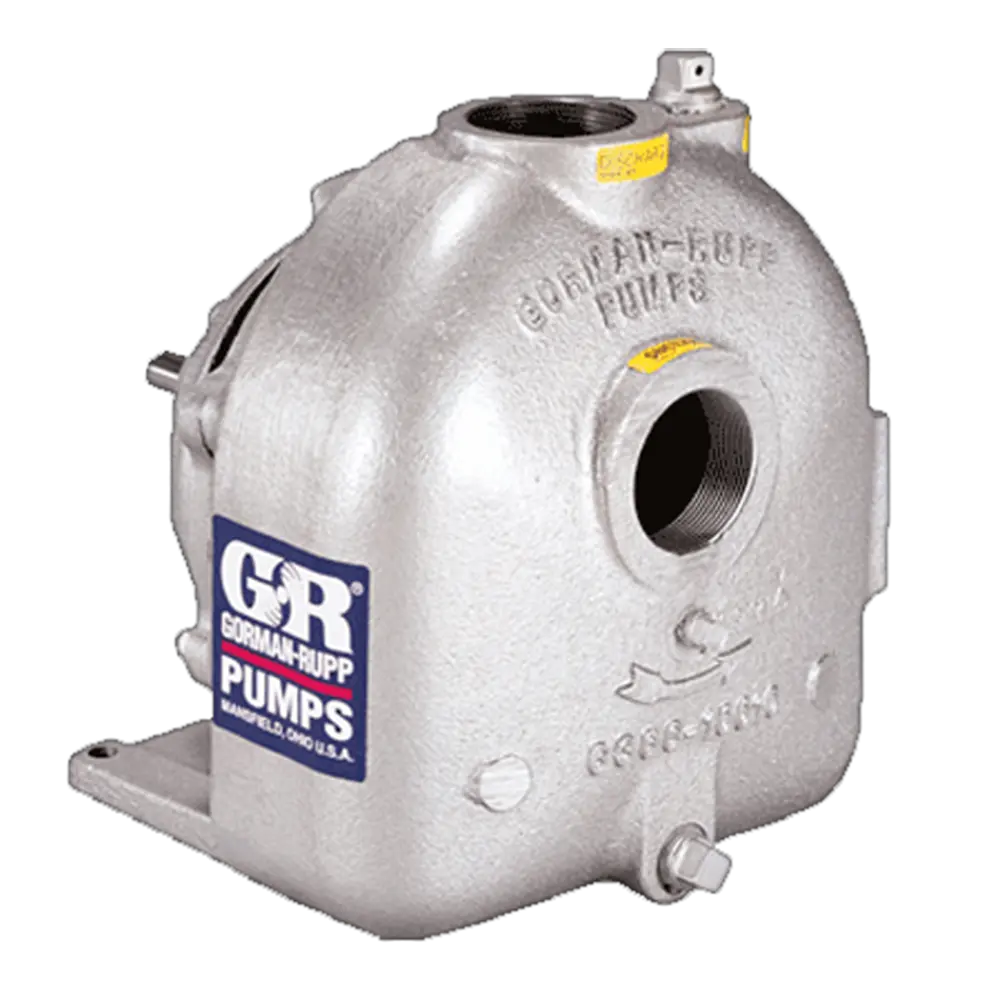
In petroleum transfer operations within the Oil & Gas industry, pumps must provide suitable hydraulic performance, reliable construction, and configurations that can be adapted to installation requirements.
The Gorman-Rupp O Series Self-Priming Centrifugal Pump is designed to handle clean liquids, petroleum products, solvents, and fluids containing no significant amounts of solids.
Several features of the Gorman-Rupp O Series that support these applications include:
Self-Priming Design
The self-priming capability allows the pump to evacuate air from the suction line, making it suitable for installations where the pump is positioned above the liquid level. This feature is useful for transfer operations involving storage tanks, tank trucks, and fuel distribution facilities.
Straight-In Suction Design
The direct suction design helps reduce inlet-side restrictions. This supports fluid entry into the pump chamber, particularly when the system requires a stable fluid supply.
Enclosed Multi-Vane Impeller
The enclosed multi-vane impeller design supports the pump’s hydraulic performance when handling fluids that meet the pump’s design characteristics.
Mechanical Shaft Seal
The O Series uses a mechanical shaft seal with fluorocarbon elastomer as the standard material. Seal compatibility must still be verified based on the petroleum product type and operating temperature to ensure suitability for the application.
Drive Configuration Options
The Gorman-Rupp O Series is available in several configurations, including pedestal-mounted, close-coupled, engine-driven, and PTO-driven options. These configurations provide flexibility for both fixed installations and transfer applications requiring mobility.
With these characteristics, the Gorman-Rupp O Series can be considered for various petroleum transfer applications in the oil and gas industry, including bulk plants, tank farms, tank truck loading and unloading operations, and fuel distribution facilities.
For gasoline and aircraft fuel applications, the compatibility of materials, mechanical seals, drive systems, and installation safety requirements must still be verified before selecting the pump configuration.
Product Catalog: View the Gorman-Rupp O Series Catalog
Conclusion
Selecting a petroleum pump for the Oil & Gas industry involves more than considering the fuel type or flow capacity. Viscosity, temperature, suction conditions, total head, drive system, and installation safety requirements must all be evaluated to ensure the transfer process meets operational needs.
PT Winston Indonesia provides Gorman-Rupp pump solutions for a wide range of industrial applications, including petroleum transfer. Contact us to discuss your fluid specifications, capacity requirements, pressure, and installation conditions to receive recommendations for a suitable pump.

Author Bio
Rian

Team PT Winston technically driven member of PT Winston Indonesia with strong practical knowledge of pumps and fluid handling solutions. We work closely with customers to understand their operating requirements, recommend suitable pump solutions, and introduce products that can improve reliability, efficiency, and overall system performance. With a hands-on and solution-oriented approach, We help bridge technical requirements with practical product selection, ensuring customers receive the right pumping solution for their applications.
See all posts by Rian »