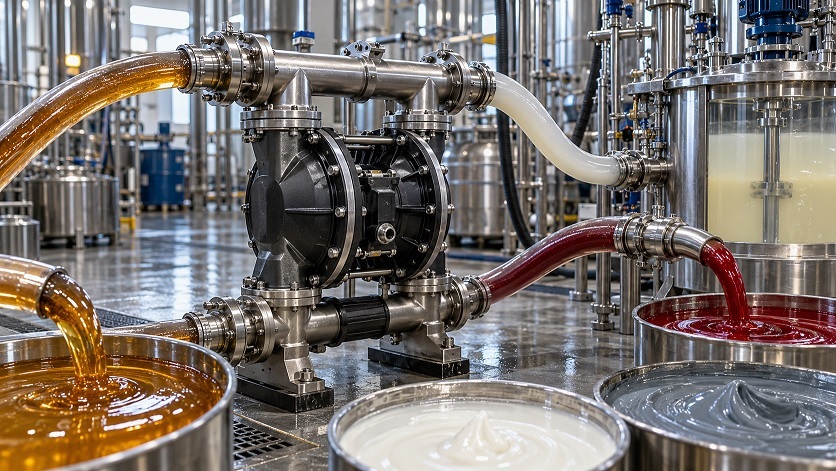
Resins, adhesives, paints, and polymers are widely used as raw materials and process materials across various industries. Although they may all be in liquid or semi-liquid form, each material can have different characteristics, particularly in terms of viscosity, temperature, solids content, and flow behavior.
These differences mean that pump selection should not be based solely on the material’s name. Resin, for example, can have different formulations with varying levels of viscosity. The same applies to adhesives, coatings, and polymers.
Therefore, before selecting a pump, it is important to understand the material’s characteristics and transfer requirements.
Why Is Viscosity Important When Selecting a Pump?
Viscosity describes a liquid’s resistance to flow. The higher the viscosity, the greater the resistance that must be overcome to move the material from one location to another.
Low-viscosity liquids are generally easier to transfer from drums or containers. In contrast, thicker materials require a pumping system capable of handling their specific characteristics.
Temperature is another important factor to consider. Some materials become less viscous as the temperature increases and more viscous as the temperature decreases. Therefore, material specifications should be evaluated under actual operating conditions.
In applications involving resins, adhesives, paints, and polymers, these characteristics can determine which type of pump is most suitable.
Electric Drum Pumps for Lower-Viscosity Liquids

For materials that remain fluid and flow easily, an electric drum pump can be a practical option for transferring liquids from drums or containers.
One available option is the FLUX Electric Drum Pump. This pump is designed to handle various types of liquids with viscosities of up to approximately 1,200 cPs, depending on the configuration and application requirements.
Its modular design allows motors to be used with different pump tube options in selected configurations. Specialized variants are also available for applications requiring ATEX compliance, FDA-related requirements, and food industry use.
Electric drum pumps can be considered for transferring coating materials, chemicals, and other products that flow relatively easily, particularly when moving liquids from drums or containers.
What If the Material Is More Viscous?

As material viscosity increases, pump selection requires greater attention. A pump suitable for thin liquids may not perform optimally when handling thicker materials.
For these applications, VISCOPOWER is one option to consider. As a progressive cavity pump that operates on the positive displacement principle, it can handle fluids with viscosities of up to 100,000 mPa·s while delivering a stable flow.
In addition, VISCOPOWER is designed to transfer materials gently with minimal pulsation, making it suitable for processes that require more controlled fluid transfer.
Key Parameters to Consider Before Selecting a Pump
Before choosing a pump for resin, adhesives, paints, or polymers, several factors should be evaluated to ensure that the pump matches the material’s characteristics and process requirements.
1. Viscosity
Determine the material’s viscosity, particularly at the operating temperature, because viscosity affects how easily the material flows and can be pumped.
2. Flow Rate
Determine the volume of material that needs to be transferred within a specific period to ensure that the pump’s capacity meets process requirements.
3. Pressure
Consider the pressure requirements based on the transfer line length, pipe diameter, and installation conditions.
4. Temperature
Temperature can affect material viscosity. Therefore, temperature conditions throughout the pumping process must be taken into account.
5. Solids Content
Pigments, fillers, and other particles in the material can influence pump selection and the choice of components.
6. Material Compatibility
Ensure that all pump components in contact with the fluid are chemically compatible with the medium being transferred.
By considering these factors, pump selection can be tailored to actual operating conditions and application requirements rather than being based solely on the type of material.
Choosing the Right Pump for Your Material
Every material has different characteristics and transfer requirements. Therefore, selecting a pump for resin, adhesives, paints, or polymers requires careful consideration of viscosity, operating conditions, and flow requirements.
For liquids that flow relatively easily, the FLUX Electric Drum Pump can be a suitable option for transferring materials from drums or containers. Meanwhile, for higher-viscosity materials, the FLUX VISCOPOWER uses progressive cavity technology designed to deliver a stable flow and handle viscous materials.
Winston Indonesia provides both solutions to support a wide range of industrial material transfer applications. To ensure that the selected pump is suitable for your application, consider the material’s viscosity at operating temperature, required flow rate, system pressure, and the characteristics of the medium being transferred.
For more information and technical assistance, please contact us to discuss your requirements with our team.

Author Bio
Rian

Team PT Winston technically driven member of PT Winston Indonesia with strong practical knowledge of pumps and fluid handling solutions. We work closely with customers to understand their operating requirements, recommend suitable pump solutions, and introduce products that can improve reliability, efficiency, and overall system performance. With a hands-on and solution-oriented approach, We help bridge technical requirements with practical product selection, ensuring customers receive the right pumping solution for their applications.
See all posts by Rian »