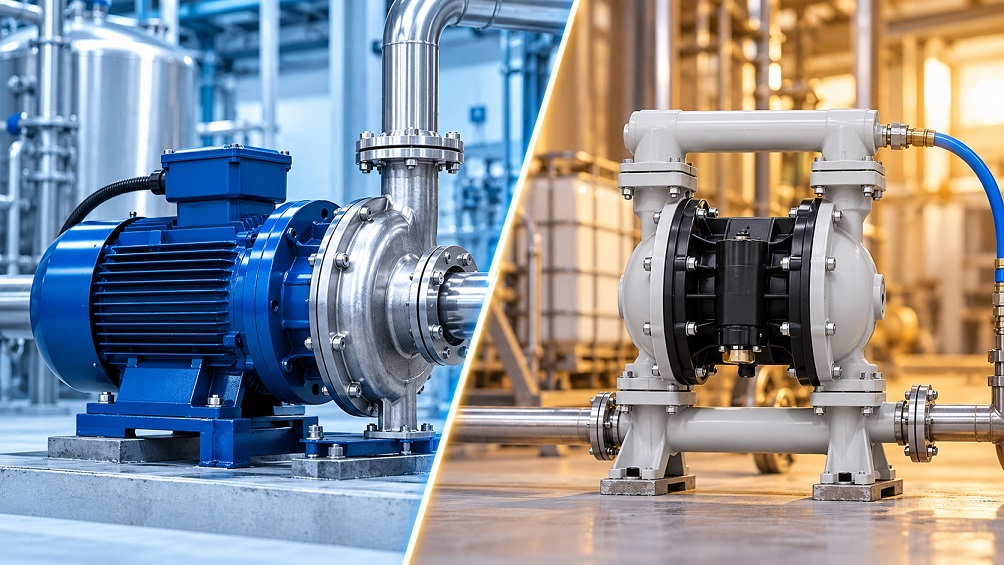
Choosing the right pump drive system is an important consideration in industrial operations. Two widely used technologies are electric pumps and pneumatic pumps, including diaphragm pumps that use compressed air as their power source.
Both technologies can be used to transfer various types of fluids, but they differ in terms of energy source, installation requirements, operation, and energy efficiency.
For companies looking to improve process efficiency, comparing electric pumps and pneumatic pumps is essential before deciding which technology best suits their applications.
What Is an Electric Pump?
An electric pump uses an electric motor as its driving mechanism. Electrical energy powers the pump mechanism, allowing fluids to be transferred according to process requirements.
One of the key advantages of this system is that it does not require a compressed air system as its primary power source. This can be an important consideration for industrial facilities looking to reduce their dependence on compressed air infrastructure.
In some applications, electric pumps can also be equipped with integrated controls to help regulate flow and pressure.
What Is a Pneumatic Pump?
A pneumatic pump uses compressed air to generate pumping action. One commonly used technology is the Air-Operated Double Diaphragm (AODD) pump.
Pneumatic systems offer several characteristics that make them widely used in industrial applications, particularly where operational flexibility and the ability to handle specific fluid conditions are required.
However, pneumatic pumps require a compressed air supply. Therefore, in addition to the pump’s own energy consumption, companies must also consider the energy requirements of the compressor and compressed air distribution system.
Electric Pump vs. Pneumatic Pump: Which Is More Efficient?
Efficiency should not be evaluated solely based on the pump’s energy consumption. The overall system must also be taken into account.
In a pneumatic system, electrical energy is used to generate compressed air through a compressor before the air is supplied to the pump. This means that several stages of energy conversion must be considered.
An electric pump, on the other hand, uses an electric motor directly as its driving mechanism.
According to Graco’s QUANTM Industrial product information, the QUANTM electric drive technology can reduce energy consumption by up to 80% and eliminates the need for compressed air.
This figure represents a manufacturer-stated performance claim based on specific comparison criteria. Actual results may vary depending on installation conditions, duty cycle, fluid characteristics, and the overall system configuration.
What About Operating Costs?
Energy costs are one of the key factors to consider when selecting a pump technology.
For pneumatic systems, operating costs are not limited to the pump itself. They may also include the costs associated with operating the compressed air system.
An electric pump can be an alternative for companies looking to simplify their drive systems and reduce their reliance on compressed air.
However, a total cost of ownership (TCO) analysis is still necessary. In addition to energy consumption, companies should consider the initial purchase price, maintenance, spare parts, downtime, and installation requirements.
Therefore, neither electric pumps nor pneumatic pumps should automatically be considered the more economical option for every application.
What About Maintenance?
Maintenance is another important factor when comparing the two technologies.
Pneumatic systems require attention to their components and compressed air infrastructure, including the quality and availability of the compressed air supply.
Electric pumps, meanwhile, require inspections of the motor, control system, pump components, and other parts according to their design.
Graco’s QUANTM Industrial product information identifies simplified maintenance as one of the benefits of its design.
For this reason, companies should evaluate maintenance requirements across the entire system rather than focusing solely on the type of drive mechanism.
When Is an Electric Pump the More Attractive Option?
An electric pump may be an attractive choice for companies that:
- Want to reduce their dependence on compressed air
- Face high compressed air operating costs
- Require flow and pressure control
- Aim to improve energy efficiency
- Need a simpler drive system
- Want to integrate pump controls with their operational systems
However, the final selection should still be based on the fluid characteristics and specific process requirements.
How to Select an Electric Pump for Industrial Applications
In addition to the drive technology, several key parameters must be evaluated:
- Flow rate: The volume of fluid that needs to be transferred within a specific period.
- Pressure: The pressure required by the system to meet process demands.
- Fluid type: Including viscosity, solids content, and chemical properties.
- Wetted parts material: Materials that come into direct contact with the fluid must be compatible with the application.
- Particle size: An important consideration for applications involving fluids containing solids.
For example, the Graco QUANTM Industrial technical specifications offer several models with different flow capacities. The i30 model has a maximum flow rate of 30 gpm, the i80 can deliver up to 80 gpm, and the i120 can deliver up to 120 gpm. Pressure ratings and available material configurations vary by model.
Graco QUANTM as an Electric Diaphragm Pump Solution
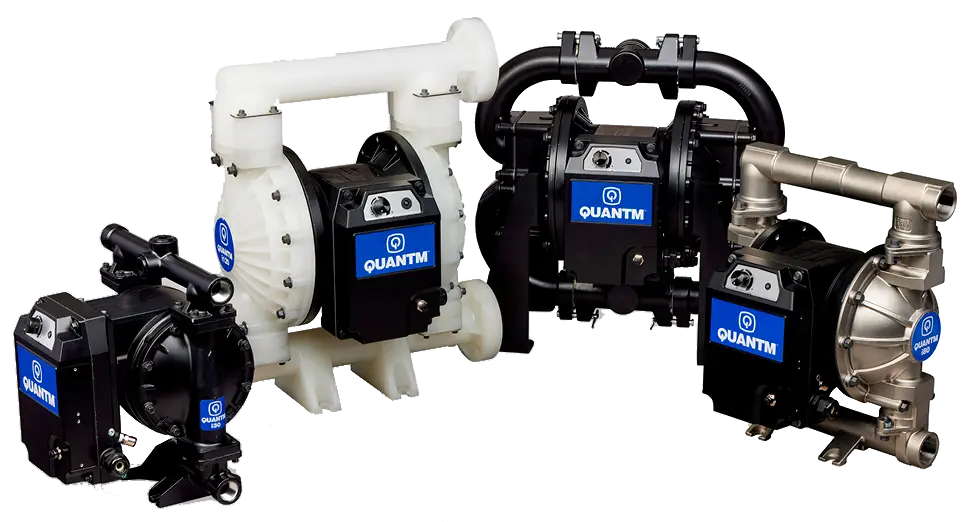
For industrial companies considering a transition from pneumatic diaphragm pumps to electric diaphragm pumps, Graco QUANTM is one option worth evaluating.
QUANTM uses an electric drive and is designed to retain several characteristics commonly sought in diaphragm pump applications, including self-priming, dry-running capability, the ability to handle solids and abrasive materials, and the ability to stall under pressure.
If your company is considering an electric diaphragm pump as an alternative to a pneumatic system, the selection should be based on flow requirements, pressure, fluid characteristics, and operating conditions.
Winston Indonesia provides product information and technical support for the Graco QUANTM Electric Double Diaphragm Pump to help companies evaluate their industrial pumping requirements. With access to product information and technical documentation, Winston Indonesia can support industrial businesses in identifying pump solutions that meet their application needs.
- For More Information: CLICK HERE

Author Bio
Rian

Team PT Winston technically driven member of PT Winston Indonesia with strong practical knowledge of pumps and fluid handling solutions. We work closely with customers to understand their operating requirements, recommend suitable pump solutions, and introduce products that can improve reliability, efficiency, and overall system performance. With a hands-on and solution-oriented approach, We help bridge technical requirements with practical product selection, ensuring customers receive the right pumping solution for their applications.
See all posts by Rian »