⚡ Quick Answer
The most effective ways to improve energy efficiency in industrial pumps and compressors are: upgrading to IE3/IE4 high-efficiency motors (5–15% savings), installing Variable Speed Drives (up to 50% savings), fixing compressed air leaks (20–30% of air is typically wasted), optimizing system design (10–25% savings), deploying smart IoT monitoring, maintaining equipment preventively, and recovering waste heat from compressors (up to 90% of input energy).
Maximum energy savings possible with Variable Speed Drive technology
Average compressed air lost to undetected leaks in industrial facilities
Of compressor waste heat that can be recovered and reused
Electricity prices are increasing across Asia in 2026 due to rising fuel costs and global energy instability. In Singapore, electricity tariffs have already increased, with expectations of further adjustments. Similar trends are seen in countries like Sri Lanka, the Philippines, and Pakistan, where businesses are facing higher energy costs. As electricity becomes more expensive, companies need to find practical ways to reduce operating expenses and improve efficiency. Industrial pumps and compressors account for a significant share of a facility’s total electricity bill. Yet in most plants, 20–50% of that energy is being wasted — not through complex failures, but through fixable inefficiencies. This guide walks through seven strategies that engineers and energy managers are deploying in 2026 to address those losses, ranked from quickest wins to longer-term investments.
Upgrade to High-Efficiency Motors (IE3 & IE4)
💰 5–15% energy savingsConventional motors lose energy as heat. Modern IE3 and IE4 motors use improved magnetic materials, tighter electromagnetic design, and better cooling to operate significantly cooler and more efficiently — which also means longer equipment life and lower maintenance frequency.
In facilities where motors run around the clock, even a modest 2–5% efficiency improvement compounds into substantial cost savings across the motor’s lifespan. The total lifecycle energy savings routinely outweigh the upfront premium by a wide margin.
- 5–15% lower energy consumption
- Reduced heat & improved reliability
- Longer operational lifespan
- Lower maintenance requirements
Install Variable Speed Drives (VSD)
💰 Up to 30–50% energy savingsMost traditional pump and compressor setups run at fixed speed regardless of actual load. During low-demand periods, this wastes enormous amounts of energy. Variable Speed Drives solve this by continuously adjusting motor speed to match real-time demand — the single largest energy-saving opportunity in most facilities.
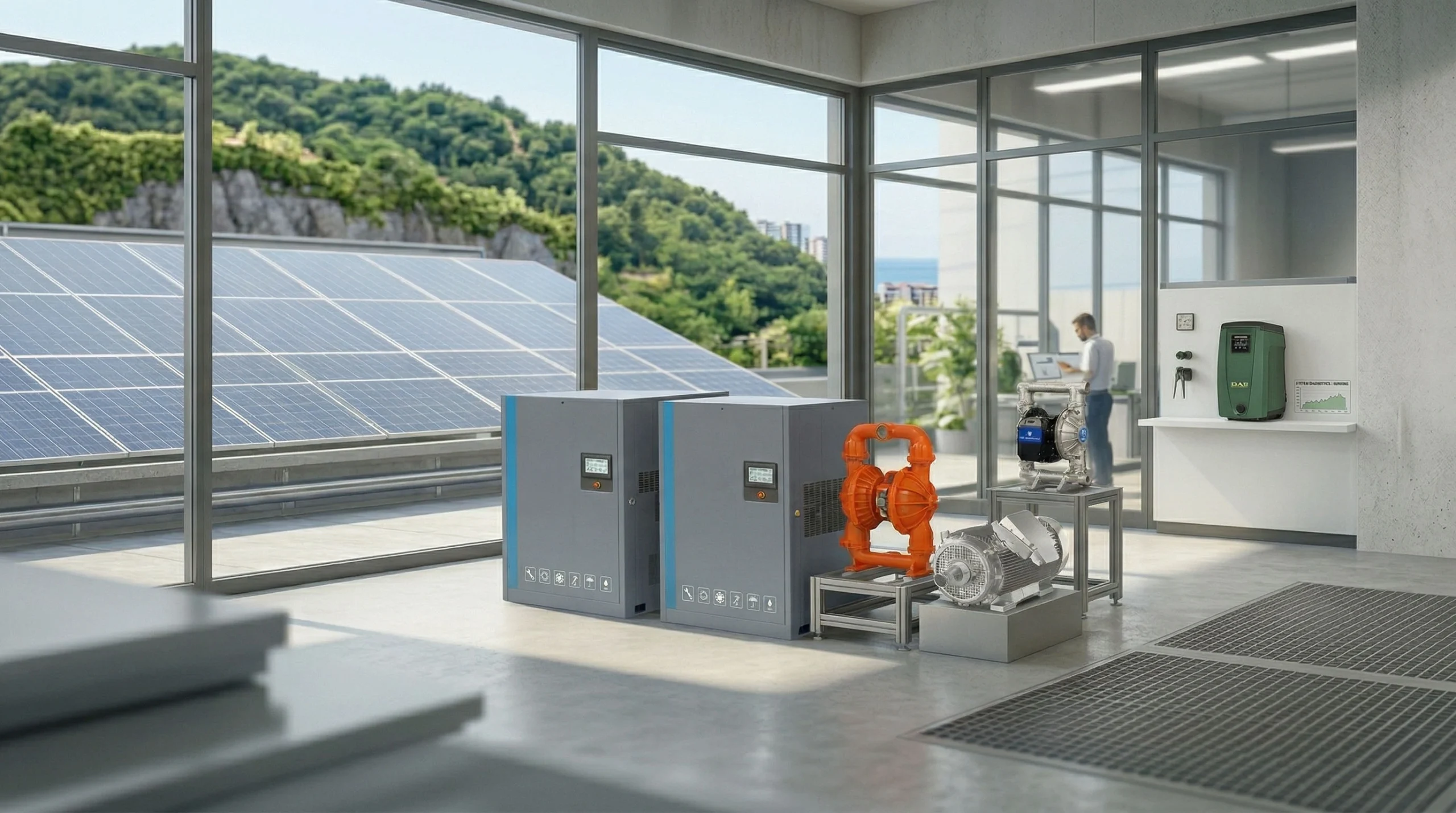
The physics behind this is powerful: due to the “affinity laws,” a 20% reduction in pump speed translates to roughly a 50% reduction in energy consumption. VSD technology is especially impactful in HVAC systems, water distribution networks, and variable-load manufacturing processes. The DAB E.sybox Integrated Booster System is a prime example — combining a variable speed drive, pump, motor, and controller into a single intelligent unit.
- Up to 50% energy savings
- Reduced mechanical stress & wear
- Smoother, more stable process control
- Lower noise & vibration levels
Proactive Leak Management in Compressed Air Systems
⚡ Fastest ROI — minimal capital requiredCompressed air is one of the most expensive utilities in any plant, and leaks are where the money quietly escapes. Studies consistently show that 20–30% of compressed air in a typical facility leaks out undetected — and every cubic meter lost is electricity paid for and wasted. Modern screw air compressors with integrated monitoring make it significantly easier to detect and trace these losses.
A proactive leak management program doesn’t require major capital investment. It requires discipline: regular audits, the right detection tools, and a culture of fix-it-now rather than fix-it-later.
- Conduct scheduled leak detection audits (quarterly minimum)
- Use ultrasonic leak detection equipment for precision identification
- Establish routine pipe and fitting inspection schedules
- Enforce an immediate repair policy — tracked and documented
System-Wide Design Optimization
💰 10–25% system-wide savingsIndividual component upgrades have limits. The next level of savings comes from looking at the entire system — how pipework is laid out, how equipment is sized, and how pressure is managed across the network.
Many systems were designed for peak loads that rarely occur, or have accumulated inefficiencies through years of modifications. Oversized equipment running at partial load, unnecessarily long or narrow pipe runs, and excessive pressure settings all force your machinery to work harder than required.
A proper system audit typically examines equipment sizing relative to actual demand, piping layout and friction losses, pressure setpoints, and flow control strategies. Addressing these issues simultaneously can yield 10–25% energy savings while also improving system stability and reliability.
Smart Monitoring & IoT Automation
You can’t optimize what you can’t measure. Modern IoT-enabled monitoring platforms provide real-time visibility into energy consumption, equipment performance, and operating conditions — enabling the shift from reactive maintenance to proactive energy management.
When sensors detect an anomaly (rising temperature, unusual pressure drop, increased power draw), operators can investigate before it becomes a failure. Over time, the data builds into a foundation for predictive maintenance and continuous optimization.
- Real-time performance dashboards
- Early fault and inefficiency alerts
- Predictive maintenance triggers
- Continuous baseline optimization
Preventive Maintenance as an Energy Strategy
💰 5–10% from maintenance aloneMaintenance is often framed purely as a reliability concern. It is also, directly, an energy concern. Dirty filters increase pressure drop. Worn seals allow leakage. Degraded lubricants increase friction. Each of these forces your pumps and compressors to consume more electricity to deliver the same output.
A structured preventive maintenance programme — covering filter replacement, lubrication checks, belt and seal inspections, and performance trending — typically recovers 5–10% of energy that would otherwise be quietly wasted. Winston Engineering’s WE Service team provides expert pump repair and scheduled maintenance across industrial facilities in Singapore and Malaysia.
- Clean or replace filters on schedule (not just when they look dirty)
- Check and maintain correct lubrication levels
- Inspect belts, seals, couplings, and connections regularly
- Track system pressure and power draw trends over time
Energy Recovery: Capture Compressor Waste Heat
🌱 Up to 90% of input energy recoveredAir compressors are essentially heat generators — the compression process converts most input electricity into heat. In most facilities, that heat is vented away and wasted. Heat recovery systems capture it and put it to work: preheating process water, space heating, or feeding industrial processes that need thermal input.
This is one of the most underutilised strategies in industrial energy management, despite offering some of the best economics. For facilities that also need efficient fluid transfer alongside compressed air, the Pro-Flo® SHIFT Series and Graco QUANTM electric diaphragm pump offer energy-saving alternatives to traditional air-operated designs.
- Recover up to 70–90% of input energy
- Reduce facility-wide energy consumption
- Cut carbon footprint meaningfully
- Strong ROI with moderate capital cost
Ready to Implement These Strategies?
Winston Engineering supplies, services, and integrates energy-efficient pump and compressor solutions across Singapore, Malaysia, and Indonesia.
Frequently Asked Questions
How much can high-efficiency motors actually save on electricity bills?
IE3 and IE4 motors typically deliver 5–15% energy savings compared to standard motors. In facilities where motors run continuously, this translates into substantial cost reductions over time — often recovering the upgrade cost within 2–4 years, depending on operating hours and local electricity tariffs.
Is it worth installing VSDs on all motors, or only some?
VSDs deliver the greatest benefit on variable-load applications: HVAC fans, cooling tower pumps, water supply systems, and process compressors where demand fluctuates. For constant-load, fixed-speed applications, the payback period is much longer. A load profile analysis is recommended before committing to VSD installation.
What percentage of compressed air is typically lost to leaks?
Most industrial compressed air systems lose 20–30% of their output to leaks — with some poorly maintained systems losing up to 40%. Because compressed air is expensive to produce (roughly 8–10x the cost of equivalent thermal energy), even small leaks represent significant ongoing cost.
How often should leak detection audits be conducted?
For most facilities, a comprehensive ultrasonic leak survey every 6–12 months is recommended, with visual walkthroughs quarterly. High-pressure or large compressed air systems benefit from more frequent checks. New leaks develop constantly as fittings and seals age, so auditing should be treated as ongoing — not a one-off project.
Can energy recovery systems be retrofitted to existing compressors?
Yes — most modern air compressors can be retrofitted with heat recovery modules. Oil-injected rotary screw compressors are particularly well-suited, as 70–80% of the input energy is already concentrated in the oil cooler circuit. Retrofit kits typically pay back within 1–3 years.
Where to Start: A Prioritised Action Plan
If you’re facing pressure to reduce energy costs and don’t know which lever to pull first, here’s a practical sequencing based on speed-of-ROI and implementation complexity:
- 1Leak audit your compressed air system — fastest payback, lowest cost to implement, often weeks to ROI.
- 2Install VSDs on variable-load pumps & fans — highest energy savings potential, typically 1–3 year payback.
- 3Deploy smart monitoring — enables all other strategies to be managed data-first going forward.
- 4Upgrade to IE3/IE4 motors — prioritise at end-of-life replacement or as capital budget allows.
- 5Conduct a system design review — pursue once quick wins are captured; requires engineering assessment.
- 6Evaluate heat recovery — especially if you have significant process or space heating demand nearby.