

Submersible Pump Installation: A Practical Malaysia Guide
Correct submersible pump installation is about much more than lowering a pump into water. Pump selection, sump dimensions, discharge piping, solids handling, water level control, electrical protection and maintenance access can all affect the reliability of the finished system.
This visual guide explains how a typical submersible pump system works, how underground or seepage water is moved to the discharge point, and what Malaysian contractors, facility teams and property owners should check before commissioning.
Know the liquid
Clean water, rainwater, seepage, wastewater and solids-laden water require different impeller designs and free-passage capabilities.
Calculate the duty
Establish the required flow, static lift, friction losses and discharge conditions before selecting the pump.
Plan for maintenance
The installation should allow technicians to safely retrieve the pump, inspect valves and clean the sump without dismantling the entire system.
How Does Submersible Pump Installation Work?
Unlike a surface-mounted pump, a submersible pump operates while immersed in the fluid being pumped. The motor and hydraulic section are contained within a sealed unit positioned below the water level.
During operation, water enters the pump inlet and the impeller adds energy to the liquid. The discharge pipe then carries the water upwards to a drain, storage tank, treatment system or another designated discharge point.
In Malaysia, common installations include basement sumps, stormwater pits, construction dewatering, factory drainage, wastewater transfer, flood-water removal, underground seepage management, ponds and residential applications.
Submersible Pump Installation Animation
Use the controls below to see a simplified installation sequence. The example shows a typical sump installation with a discharge pipe, check valve, water-level control and electrical control panel.
What are you pumping?
Select the application closest to your project. This is a preliminary guide only; final pump selection should be based on the actual duty point and liquid characteristics.
6 Key Steps for a Submersible Pump Installation
| Step | What to check | Why it matters |
|---|---|---|
| 1. Establish the duty | Required flow, static lift, pipe length, fittings, discharge pressure and liquid characteristics. | An incorrectly sized pump may operate away from its intended duty point, resulting in poor performance or unnecessary energy use. |
| 2. Inspect the sump | Sump dimensions, floor condition, incoming flow, sediment and available pump clearance. | Adequate clearance helps water reach the pump inlet and allows water-level controls to operate without obstruction. |
| 3. Position the pump | Use the intended lifting handle, chain or guide-rail arrangement. | The electrical cable should not be used to lift or support the pump. |
| 4. Install the discharge | Pipe size, check valve, isolation valve, supports and removable connections. | Correct pipework limits unnecessary pressure losses and makes future pump servicing easier. |
| 5. Set water-level control | Float-switch travel, ON/OFF levels and minimum operating level. | The float or level sensor must move freely and prevent undesirable rapid cycling. |
| 6. Test and commission | Flow, discharge, automatic operation, abnormal vibration, leakage, electrical protection and alarm functions. | Commissioning confirms that the installed system behaves as intended under actual site conditions. |
How Does Water Flow From Underground?
A drainage sump is normally positioned at a low point so that groundwater, rainwater or seepage can enter the pit.
-
Water enters the sump.
Gravity directs water towards the low point or collection pit. -
The water level rises.
A float switch or level sensor detects when the start level has been reached. -
The submersible pump starts.
Water enters the pump inlet and is pressurised by the hydraulic section. -
Water travels upwards.
The discharge pipe transports the water above ground or towards the designated drainage or treatment system. -
The pump stops automatically.
Once the lower water-level setting is reached, the control system stops the pump.
What Should Be Considered for a Submersible Pump Installation in Malaysia?
Pump installations in Malaysia frequently deal with heavy rain, underground seepage, stormwater, wastewater and high ambient humidity. Rather than selecting a pump by motor power alone, the complete system should be considered.
✓ Good installation practice
- Define required flow and total head.
- Confirm the largest expected solids.
- Provide sufficient sump dimensions.
- Keep the pump inlet clear of excessive sediment.
- Provide a check valve where required by the system design.
- Provide an isolation valve for maintainability.
- Secure power cables away from moving floats.
- Use the designated lifting point or lifting chain.
- Allow adequate access for future pump removal.
- Test automatic start/stop operation during commissioning.
✕ Common installation mistakes
- Selecting a pump solely by kW or horsepower.
- Ignoring friction loss in long discharge pipework.
- Using a small discharge pipe simply to match existing piping.
- Allowing a float switch to hit the pump or pit wall.
- Installing the pump directly in deep accumulated sludge.
- Supporting the pump using its electrical cable.
- Preventing technicians from accessing the check valve.
- Ignoring maximum solids size.
- Failing to verify the actual operating point.
- Skipping commissioning after installation.
Submersible Pumps for Different Installation Requirements
The required submersible pump depends on the water being handled, desired flow, total head and solids size. The examples below illustrate why two visually similar submersible pumps may be intended for very different duties.
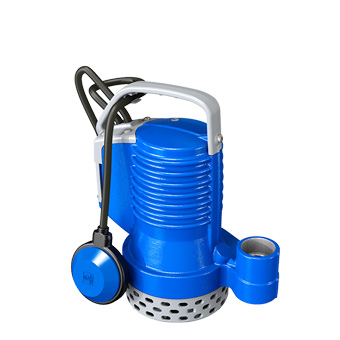
Zenit DR BLUE 40 Series
A drainage-type submersible pump suited to clear or slightly soiled wastewater, including rainwater, seepage and underground pump-out water.
Rated output: 0.3 kW
Maximum flow: 163.7 L/min
Maximum head: 7.0 m
Maximum grain size: 7 mm
View DR BLUE 40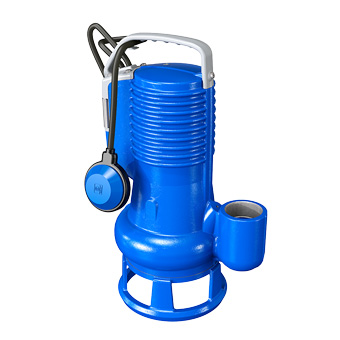
Zenit DG BLUEPRO 100 Series
A vortex-type wastewater submersible pump designed for more heavily soiled wastewater and applications where larger solids passage is required.
Rated output: 0.74 kW
Maximum flow: 420 L/min
Maximum head: 11.4 m
Maximum grain size: 40 mm
View DG BLUEPRO 100Information Needed to Size a Submersible Pump
Providing accurate site information allows a pump engineer to recommend a more appropriate solution. Before requesting a quotation for a submersible pump installation, prepare the following:
| Information | Example | Why it is needed |
|---|---|---|
| Liquid | Rainwater / wastewater / clean water | Determines pump hydraulic design and materials. |
| Required flow | L/min or m³/h | Establishes required pumping capacity. |
| Vertical lift | Metres | Contributes to total dynamic head. |
| Discharge pipe | Diameter, length and material | Used to estimate system friction losses. |
| Solids | Maximum particle size | Determines the required free passage or impeller type. |
| Sump dimensions | Length × width × depth | Helps determine installation clearances and level controls. |
| Electrical supply | Voltage / phase / frequency | Ensures compatibility with the motor and control system. |
| Site photographs | Sump, existing pump and discharge pipe | Helps engineers identify practical installation constraints. |
Submersible Pump Installation FAQs
Can a submersible pump sit directly on the bottom of a sump?
It depends on the pump design and condition of the sump. Excessive sediment or sludge can obstruct the pump inlet and increase wear. The manufacturer's installation requirements should be followed and the sump should be maintained appropriately.
Should I lift a submersible pump using its electrical cable?
No. Use the pump's designated lifting point, handle, lifting chain or the retrieval arrangement specified by the manufacturer.
Does a submersible pump need a check valve?
Many pumped discharge systems use a check valve to prevent water in the rising main from flowing backwards after the pump stops. Whether one is required and where it should be installed depends on the system design.
Why does a submersible pump start and stop too frequently?
Possible reasons include unsuitable float settings, an undersized sump, high incoming flow, an incorrect pump selection or a problem with the level control. Frequent cycling should be investigated rather than treated as normal operation.
What information should I provide when requesting a pump?
Send the required flow and head, liquid type, estimated solids size, sump dimensions, discharge pipe information, electrical supply, operating requirements and photographs of the installation.
Can the same submersible pump handle clean water and sewage?
Not necessarily. Pumps for clear or lightly contaminated water may use a different impeller and solids passage from pumps intended for sewage or heavily contaminated wastewater. Selection should be based on the actual liquid being pumped.
Planning a Submersible Pump Installation in Malaysia?
Send Winston Engineering your required flow, head, liquid type, solids size, sump dimensions and site photographs. Our team can help you evaluate the pump and system requirements for your application.

Author Bio
Irfan

Team Winston Engineering Malaysia brings together pump specialists, engineers, and industry professionals with extensive experience in pumping and fluid management solutions. Serving customers across Malaysia, the team provides practical technical advice, reliable product recommendations, and responsive support for applications in water treatment, manufacturing, building services, oil and gas, power generation, and general industry. Backed by the regional expertise of Winston Engineering Group, the Malaysia team combines strong local market knowledge with proven engineering capabilities to help customers achieve reliable, efficient, and cost-effective pumping solutions.
See all posts by Irfan »